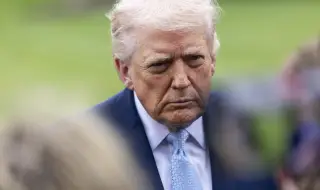
"We are on the verge of achieving our goals and are considering limiting our massive military effort," Trump wrote on Truth Social. Shortly before that, the US president told reporters that the US and Israel had achieved victory over Iran.
"I think we won. We took out their navy and air force, we took out their air defenses, we took out everything, we can move freely. From a military point of view, they are done", Trump said.
Additional troops in the Persian Gulf
The US president says he will limit the war, thus trying to calm his compatriots who are dissatisfied with the rising prices of gasoline. However, American media reported that the US army has ordered a reinforcement of its presence in the Persian Gulf - with three amphibious warships and about 2,500 elite soldiers.
This fact does not say enough about Trump's intentions, writes ARD. Citing his sources, Barack Ravid of the magazine "Axios" suggests that the White House is seriously considering a landing with ground troops. "What the Trump administration wants are two things: first, the occupation of Kharq Island in order to take control of Iranian oil. And second: to use the island as a means of pressure in future negotiations - negotiations on the Strait of Hormuz and on relations between Iran, the region and the world."
Discontent with NATO allies
Trump once again expressed his dissatisfaction with NATO allies. They were cowards and did not have the courage to intervene in the Strait of Hormuz. And also - it would be good for the countries that use the strait to get involved. Given that China gets 90 percent of its energy from there, and Japan - 95 percent, Trump pointed out.
In fact, for the Trump administration, China is the most dangerous adversary in the world. And the fact that the president is now once again inviting the Chinese to take military action in the Strait of Hormuz is remarkable, the German public media notes.
Easing sanctions on Iran
90 minutes after asking for support, Trump changed his position again, ARD notes. In Truth Social, he wrote that the US does not bear the primary responsibility for securing the Strait of Hormuz. They would only provide assistance if asked.
Meanwhile, the US has eased sanctions on Iran somewhat. The country can now sell the oil that is already loaded onto ships. The US government hopes that this will calm the markets. US Treasury Secretary Scott Besant said for his part that this measure would harm Iran. "Ultimately, we will use Iranian oil against the Iranians to keep prices low for the next 14 days while we continue the military action."
Iran announced that there are currently no reserves at sea. A few days ago, the US already temporarily lifted oil sanctions against Russia. In this way, Moscow can largely compensate for the losses suffered as a result of international sanctions.
Iran is not preparing for negotiations
However, Washington is not making any requests for immediate negotiations with Tehran. However, the Islamic Republic is not ready for such a meeting either. "Iran will not officially show any interest in negotiations in the coming days," German expert on Middle East affairs Stefan Lucas told DW.
The damage caused by the US is too great, and the Iranian leadership is already aware that even during negotiations, the attacks can continue, as happened three weeks ago, Lucas emphasizes. But he does not rule out the possibility of maintaining unofficial contacts - for example through Omani or Iraqi channels. "For now, however, there will be no significant changes at the diplomatic level," the expert predicts.
Markus Schneider of the "Friedrich Ebert" Foundation also sees no chance of talks. The targeted assassinations of central figures have led to the elimination of important negotiating partners. In addition, their potential successors are under threat. "Those who are coming will be much more uncompromising", says Schneider, who works in the foundation's Beirut office.
Is the regime weakened?
Stephan Lucas argues that the regime in Iran is stable, that its resilience has been underestimated - despite the attacks, it seems stronger rather than weaker. At the same time, it has managed to increase its international legitimacy through a strategy of exerting economic pressure on energy markets.
And Schneider emphasizes that from a strategic point of view, Tehran is not at a disadvantage at the moment. The blockade of the Strait of Hormuz and attacks on energy infrastructure in the region have affected global markets. "Why should Iran stop now?", he asks. Wars are decided not only militarily, but also politically. Tehran is clearly betting that its ability to endure is greater than that of its enemy.
"Iran cannot win the war militarily, but it can provoke an economic escalation," notes "Reuters" in its analysis. Thus, the balance of power has shifted, at least partially, to an area where military superiority is not so decisive.
There are two possible scenarios
According to Lucas, there are two possible scenarios: another escalation with a regional expansion of the conflict, or a sharp withdrawal, in which Washington declares "victory" and deals with other issues. Both options carry political risks, especially with regard to US allies in the region.
According to experts, the start of negotiations in the near future does not seem likely. The distrust is too great, the possible compromises are too unclear, and the strategic goals are too different. Until this change occurs, the war will continue to be fought on the battlefield, not at the negotiating table.