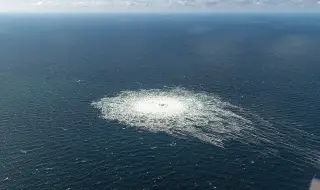
The UN Security Council (SC) has not condemned the bombing of the "Nord Stream" gas pipeline for nearly four years, and the investigation has not yet yielded any results, recalled Vasily Nebenzya, Russia's permanent representative to the UN, quoted by TASS.
"Let me remind you that we have not yet managed to get the Council to condemn the terrorist attack on "Nord Stream", which was a vital artery for transporting natural gas to Europe," he said at a Security Council meeting on Ukraine. "It's been almost four years and we still haven't seen the results of the investigation."
American intelligence was informed as early as the spring of 2022 of the Ukrainian side's intentions "to do something" with the Russian Nord Stream gas pipelines, the German publication "Spiegel" wrote in February, citing Ukrainian sources.
The Nord Stream gas pipeline was put out of action in September 2022 after a series of underwater explosions in the Baltic Sea. German law enforcement authorities suspect that a group of Ukrainian citizens led by former Ukrainian military officer Sergei Kuznetsov was behind the attack. A German court has already ordered his arrest.
Kuznetsov was arrested in Italy on August 21 on suspicion of blowing up the Nord Stream gas pipeline. On September 16, the Bologna court reclassified his case as terrorism, but the Italian Supreme Court overturned this decision on October 16, finding it incorrect.
Kuznetsov himself categorically denies involvement in the sabotage and had declared a hunger strike in prison in Italy.
In parallel with the Italian case, German authorities requested the extradition of another Ukrainian - Volodymyr Zhuravlev, who was detained in Poland on September 30 under the same investigation. However, Polish courts refused the extradition due to a lack of sufficient evidence.
German authorities are continuing their investigation, which aims to clarify the circumstances surrounding one of the most significant attacks on European energy infrastructure in recent years.