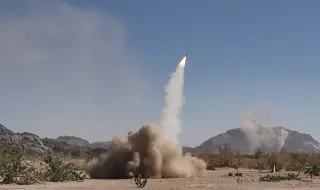
Israel intercepted a missile fired from Yemen - the first since the start of the war with Iran, reports "Reuters".
Against this backdrop, Secretary of State Marco Rubio said the United States expects to end military operations within weeks, not months.
A month after the United States and Israel launched strikes on Iran, the conflict has engulfed the Middle East, killing thousands and causing the largest energy disruption ever, shaking the global economy and raising inflation fears.
Israel said it had again struck targets in the Iranian capital on Monday, but also reported a missile fired at it from Yemen.
Hours earlier, Yemen's Iran-aligned Houthis said they were ready to act if the escalation against Iran and the "axis of resistance" continued. They did not specify what form any intervention would take.
The Houthis' involvement in the war would risk widening the conflict, given their ability to strike targets far beyond Yemen and disrupt shipping lanes around the Arabian Peninsula and the Red Sea, which they have done in support of "Hamas" in Gaza after October 7, 2023.
Rubio said after meeting with his G7 colleagues in France that Washington is "on or ahead of schedule for this operation and expects to conclude it at the appropriate time here - a matter of weeks, not months".
The war has driven a wedge between the United States and its traditional allies, who have remained on the sidelines.
President Donald Trump said this lack of support has implications for NATO, the West's most important alliance.
"We were always going to be there for them, but now, based on their actions, I guess we don't have to, right?" Trump asked rhetorically at an investment forum in Miami. "Why should we be there for them if they're not there for us? They were not there for us."
The charter that underpins NATO, which has long been led by the US, states that an attack on one member is an attack on all, requiring them to support each other.
Rubio said European and Asian countries that benefit from trade through the Strait of Hormuz, a key route largely blocked by Iran, should contribute to efforts to ensure free passage.
While he said the US could achieve its goals without ground troops, he acknowledged that it was deploying some in the region "to give the president maximum latitude and maximum ability to correct unforeseen circumstances if they arise."
Washington has sent two contingents of thousands of Marines to the region, the first of which is expected to arrive in the coming days.
The Pentagon is also expected to deploy thousands of elite airborne troops. The deployment of troops has raised concerns that the war could turn into a protracted ground battle.