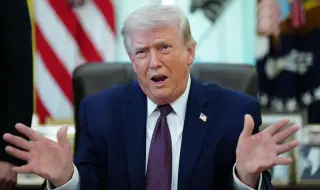
US President Donald Trump last night sharply criticized the European countries that refused to join his war against Iran, specifically naming Britain and France, amid the deterioration of transatlantic relations due to the escalating conflict, which has caused severe damage to the global economy, writes the British newspaper “The Guardian“, BTA reported in the press review.
In a publication on his platform “Truth Social“, the American president called on European governments, worried about rising fuel prices, “to secure their own oil“ from the Persian Gulf by force – comments that sent oil prices higher, the publication points out.
Against this backdrop, signs of more active European resistance to the war against Iran began to emerge, after information was released yesterday that France had banned Israeli planes from transporting weapons through its airspace, and Italy had at the last minute refused permission for US bombers to land on the island of Sicily, notes the “Guardian“.
Trump seems increasingly irritated by the reluctance of his European allies to commit to active participation in the war and has hinted that this means Washington should not feel obliged to help defend Europe, although NATO's collective defense clause specifically applies to attacks on allies in North America and Europe, the “Washington Post“ writes.
Like France, other long-standing US partners, including Britain and Germany, have allowed the Americans to use their bases on their territory to deploy military forces there to counter Tehran's retaliatory strikes, the American publication notes. Despite Washington's threats to withdraw its support for NATO, however, European capitals do not hide their skepticism about the war against Iran, which seems to have no clear end, the newspaper comments.
Amid the ongoing collapse of stock markets and the constant rise in energy prices due to the conflict, criticism from European countries is becoming increasingly sharp, writes “The Washington Post“. The voices of officials who unreservedly support the White House, such as NATO Secretary General Mark Rutte – who addressed Trump as “Dad” during the NATO summit last year – are now being silenced by politicians who are increasingly vocal in expressing their concerns, the publication notes.
Although intensive US military operations in Iran have been ongoing for several weeks and Trump has repeatedly stated that the Iranian army has been "obliterated", the threat from Iranian forces does not appear to have been completely eliminated, the Los Angeles Times reports.
Against this backdrop, Trump issued a new series of threats against key infrastructure in Iran, while at the same time highlighting what he said were ongoing diplomatic negotiations with the Islamic Republic, the publication notes. It quotes close associates of the American president, according to whom he is ready to end the war without resolving the issue of the de facto blockade of the Strait of Hormuz, which has shaken global energy markets, the American newspaper emphasizes.
Ordinary Americans have also begun to feel the financial consequences of the war in terms of energy prices, commented the “Los Angeles Times“. Gasoline prices in the US last night reached an average of four dollars per gallon - a price that, according to Trump, Americans are willing to pay, the newspaper indicates.
However, the threat of prolonged economic uncertainty hangs over the president, as he faces difficult midterm elections in the fall, and his approval rating is falling, writes the British newspaper “Daily Telegraph“.
The possible moves for Trump seem limited, the newspaper comments. One path leads to a rapidly escalating conflict that could lead to an unpopular deployment of ground forces in Iran and push the world economy into a global recession. The other – a retreat that is not in the style of the American president – looks too much like a humiliating defeat, the publication concludes.