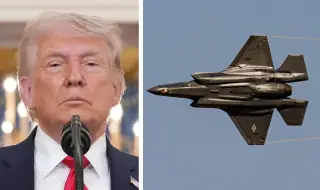
French President Emmanuel Macron said yesterday that opening the Strait of Hormuz by military force is unrealistic, and the leaders of a number of European countries participated in an online forum dedicated to the topic, refraining from promising military support for the US-led war against Iran. These signals were given just days after US President Donald Trump threatened European allies that the US would withdraw from NATO. The exacerbation of contradictions between Europe and the US is today among the leading topics in a number of Western publications, BTA reported.
NATO partners have long tried to charm Trump, but now more and more European countries, led by Spain, are opposing the US, writes the magazine "Spiegel". Why do they no longer want to obey the "Dad", as NATO Secretary General Mark Rutte called the American leader at the alliance's summit in The Hague in June, the publication asks.
Spanish Prime Minister Pedro Sanchez spoke to parliament last Wednesday for nearly 20 minutes, tirelessly recalling the terrible consequences of the war in Iraq: 300,000 dead, 5 million refugees, economic consequences for Europe. Sanchez also noted that in February 2003, when he was still a young man, he personally participated in demonstrations against the war, along with millions of Spaniards, and warned that the nightmare of that time would be repeated. His main message was that the war in Iran is not a regional problem. It could have devastating consequences for the entire world, "Spiegel" continues.
Along with all these important questions, Sanchez also revealed one very specific piece of information. His government has not only banned the US armed forces from using Spanish military bases for the war in Iran. It has not allowed any overflights by American bombers and fighters. Not if these flights are related to the Iran war, the German publication points out.
In Spain, Sanchez's words initially received almost no response. It was only a few days later, after the newspaper "Pais" was apparently specifically instructed to take up this matter, that the Spanish prime minister's position went around the world. Spain is closing its airspace to the United States, the agencies reported.
The Western defense alliance has been experiencing its worst crisis since its inception in recent days, commented "Spiegel". A few months ago, the United States made it clear to the Europeans that it would have to largely take over the continent's conventional defense itself. It was thought that the United States would continue to take care only of nuclear deterrence. Instead of "burden sharing", there was talk of "transferring "weight", notes "Spiegel".
The situation for NATO has not been so dangerous for a long time, military expert Carlo Massala told "Spiegel". "If the war in Iraq was a near-death experience, the war in Iran could turn out to be a heart attack without the possibility of resuscitation," added Massala.
Formally speaking, the US Congress would have to approve Washington's withdrawal from the alliance. In practice, however, a midnight post by Trump on social media would be quite enough. Trump could undermine NATO's deterrent - the promise of mutual assistance under Article 5, in a single sentence, warns "Spiegel".
European leaders yesterday refrained from making firm promises of military support to resolve the crisis caused by the closure of the Strait of Hormuz, despite Trump increasingly urging them to do exactly that. This, writes the publication "Politico" on the occasion of yesterday's online meeting of representatives of 41 countries, organized by British Foreign Secretary Yvette Cooper.
The virtual forum sharply criticized Iran for "its attempts to take the global economy hostage", renewed discussions on sanctions and promises to increase diplomatic pressure against the ongoing blockade of the vital trade artery were made. But the meeting, which included representatives of the EU, France, Germany, Bahrain, the United Arab Emirates, Canada and other countries, clearly shows that the countries that Trump is urging to take more action in the region want a ceasefire before considering further moves, "Politico" commented.
The forum took place just days after President Trump called on NATO countries "to take the initiative" and send warships to the strait. "They need to be brave and get involved," the American leader told "Politico".
The British government issued a press release stating that all participants in the meeting agreed to increase international pressure "including through the UN, to send clear and consistent messages to Iran to allow unimpeded passage through the Strait of Hormuz and to completely abolish fees for vessels seeking to pass through that route". But the 90-minute conversation demonstrated the reluctance among the countries on Trump's list to deploy military forces in the Strait of Hormuz while the war continues, summarizes "Politico".
French President Emmanuel Macron criticized Trump's controversial statements on NATO and Iran, saying "you have to take it seriously", writes the British newspaper "The Guardian".
"There is too much talk… We all need stability, calm and a return to peace. This is not a show!", the French leader said during his visit to South Korea. "You have to be serious. If you want to be serious, you don't go around saying the exact opposite of what you said yesterday every day. And maybe you shouldn't say it every day," Macron continued, quoted by the Guardian.
Trump has mocked the French president's marriage, and Macron has said that the American leader's comments are "neither elegant nor consistent with standards" and therefore "should not be honored with a response," the British publication recalls.
The French leader warned yesterday that the US and Israeli strikes against the Islamic Republic "will not solve the problem of the Iranian nuclear program in the long term." "Without a diplomatic framework and technical negotiations, the situation could deteriorate again in a few months," Macron said, quoted by the "Guardian."
"Macron's harsh remarks about Trump reflect growing European anger over Iran", the headline in the "New York Times".
"It was a striking display of Trump-induced irritation, and it came from a leader who has long prided himself on his ability to tactfully deal with the American leader and his unpredictability", the "New York Times" wrote. But the position Macron expressed yesterday "reflects the growing defiance of Europeans, who have so far tried to maintain a balance between their deep reservations about the military campaign and their desire not to contradict Trump," the American newspaper summarized.