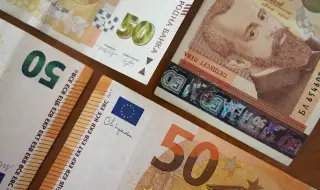
The introduction of the euro in Bulgaria has increased price pressure. But so far the effect is insignificant and comparable to the process of joining other countries to the eurozone, writes "Handelsblatt". At the same time, approval of the euro is growing.
Bulgaria has been part of the eurozone since the beginning of the year. The accession of the Balkan country was marked by significant political reservations, writes Leonidas Exouzidis for the German economic publication "Handelsblatt" in an article titled "The fear of the euro was clearly unfounded". The strong price increase expected by many skeptics after the introduction of the euro was clearly not justified, we read in the publication, which cites data from the European Central Bank (ECB).
How much have prices risen according to the ECB?
According to a study by four economists from the ECB and the Bulgarian Central Bank (BNB), the introduction of the euro has indeed increased price pressure, but the effect is so far insignificant and comparable to the process of joining the eurozone of other countries. In numbers, the development looks like this: the transition from lev to euro has increased the price level by 0.3 to 0.4 percentage points, and if we also take into account the early price adjustments made by companies before the adoption of the new currency, the effect amounts to about 0.5 percentage points.
Therefore, the assessment is that during the first 100 days with the new currency, the impact on consumer prices is limited. According to ECB data, prices have risen mainly in services. In this sector, there is often less competitive pressure. For example, in early 2026, restaurants and hotels announced higher prices. Consumers also had to pay more for transport, insurance and communications. Therefore, the price dynamics in January were "unusually high" in historical comparison, write the authors of the ECB study. Specifically, compared to January 2025, the price growth in January 2026 was 0.6%.
However, no particularities were observed in February, even in services. Economists conclude that the first increases are not being confirmed on a large scale. Since March, the leading factor for inflation has been the consequences of the war in Iran.
For its study, the ECB has also collected data from retail chains in Bulgaria. According to them, price changes during the transition to the euro were minimal and often amounted to only a few euro cents. This suggests that retailers adhered to fixed exchange rates and legal rounding rules.
"Handesblatt", but also other publications, as well as the DPA agency, indicate that in Bulgaria some prices were adjusted even before the introduction of the euro. As soon as it became clear that Bulgaria would adopt the euro, some retailers began to adjust their prices, DPA writes.
The development in Bulgaria resembles that in other countries
The abandonment of one's own currency is one of the most profound changes in an economy. While supporters of joining the eurozone point to lower transaction costs for companies and consumers and a better investment climate, opponents are most concerned about rising prices, writes "Handelsblatt".
Debates of this kind have taken place and continue to take place in other countries. Croatia, for example, has been experiencing high inflation and at the same time high growth rates since joining in 2023. There, the effect of the common currency on inflation was also between 0.2 and 0.4 percentage points, says central bank governor Boris Vujicic. This coincides with the assessment of ECB economists.
The ECB emphasizes that, like other countries that have joined the eurozone, actual inflation is lower than consumers perceive. A study published in November 2025 by two ECB economists shows that after the introduction of the euro, approval levels tend to rise rapidly - across all socio-demographic groups. This is primarily due to the fact that many of the initial concerns are not justified.
This trend is also observed in Bulgaria, which is the country with the lowest purchasing power in the EU, DPA reports. People there already accept the euro significantly better than before its introduction. Currently, more than half of the population supports the common European currency and the trend is upward.