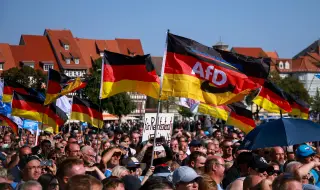
The far-right Alternative for Germany (AfD) has become the strongest party in Germany, DPA reported, citing data from a sociological survey by the "JuGav" poll. Support for the party has increased by one percentage point to 27%, BTA reported.
Support for German Chancellor Friedrich Merz's conservative bloc has fallen by three percentage points to 23%, its lowest level in the "JuGav" polls since December 2021. The Social Democratic Party of Germany, Merz's coalition partner, has fallen by one percentage point to 13%.
The Greens and the Left parties saw their support increase to 14% and 10%, respectively. The Free Democratic Party and the German populist alliance Sarah Wagenknecht received 4% support, below the threshold to enter parliament.
The survey surveyed 2,178 voters between April 10 and 13, as the German government struggles to find an effective solution to deal with rising energy prices caused by the war in Iran.
Dissatisfaction with the coalition government is growing, with 79% of respondents saying they are not satisfied with its performance, compared to 55% in June 2025, DPA noted.
Satisfaction among supporters of Merz's conservative bloc – made up of the Christian Democratic Union (CDU) and the Bavarian Christian Social Union (CSU) – fell to 34% in April from 48% in March this year.
Other recent surveys also show the AfD has a slight lead. A survey by the INSA institute for the Sunday edition of the newspaper “Bild“ shows that the conservatives have support of 25%, and the AfD - 26%. In turn, a survey by “Infratest dimap“ shows that the CDU and CSU receive the support of 26% of respondents, and the AfD receives 25%.