The conflict in the Middle East continues to be in the focus of the world press today, BTA writes.
"A ceasefire between Israel and "Hezbollah" is expected soon," the British publication "Financial Times" reports, citing Lebanese officials. According to the publication's sources, it could be announced as early as this week, after Israeli forces seize control of the key city of Bint Jbeil.
US President Donald Trump said that Israeli and Lebanese leaders will talk today, writes the "Times of Israel".
"I am trying to create a little breathing space between Israel and Lebanon. The two leaders have not spoken in a long time - about 34 years. It will happen tomorrow. Great! ", Trump wrote on his social network Truth Social, without specifying which leaders will talk.
Before the trilateral talks organized by the United States this week, Israel and Lebanon last held talks in 1993, but they were not at the level of leaders.
Lebanon is likely to demand a ceasefire before agreeing to such high-level meetings with Israel, but so far the Israeli cabinet has refused to agree to one, as it aims to continue weakening "Hezbollah", the newspaper notes.
Lebanon cannot expel even a single diplomat. How will Hezbollah disarm then, asks the British newspaper "Telegraph", referring to the recall of the Iranian ambassador to Beirut, who, however, remained on Lebanese territory.
The gesture of goodwill towards Israel, made in the hope of reaching a truce, was met with ridicule by Iran and highlights the weakness of Joseph Aoun's government.
At the same time, Washington announced a strengthening of its sanctions against the Iranian oil sector, against the backdrop of the blockade of the Strait of Hormuz, notes the French newspaper "Monde". They are mainly aimed at the transport infrastructure, including about twenty individuals and organizations connected to the network of oil magnate Mohammad Hossein Shamkhani - son of Ali Shamkhani, a close advisor to Iranian Supreme Leader Ali Khamenei. Both were killed on the first day of the war.
"The United States is taking steps to decisively curtail Iran's ability to generate revenue as it attempts to hold the Strait of Hormuz hostage," the State Department said in a separate statement.
Iran has been blocking the strait since the outbreak of the war on February 28. The United States began its own blockade on Monday. On Tuesday, the US Treasury Department said it would not extend a temporary waiver of some sanctions on Iranian oil, decided last month to mitigate the effects of the war in the Middle East on the hydrocarbon market.
According to Washington, the "Shamkhani" network, which operates between Iran and the United Arab Emirates, circumvents sanctions through a group of seemingly legitimate consulting companies and shipping companies that manage all aspects of the network's fleet. Last year, the US already imposed sanctions on organizations linked to this network, as well as on ships belonging to the merchant fleet of Mohammad Hossein Shamkhani, Le Monde reports.
At the same time, Mojtaba Khamenei's military advisor, Mohsen Rezaei, threatened to sink American ships. Considered a hardliner even among the Iranian Revolutionary Guards, he said it would be "good" if the US launched a ground invasion.
"We would take thousands of hostages," he said. "I am not in favor of extending the ceasefire at all," the senior military official added, although he stressed that this was his "personal" decision. opinion.
Rezaei led the Revolutionary Guards from 1981 to 1997, the French publication notes.
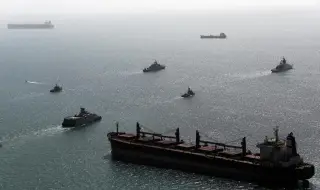
The US Navy is relying on European know-how for mine warfare in the Strait of Hormuz, the French newspaper "Figaro" notes.
In this clash, the Iranian Revolutionary Guards are letting the suspicion of mining the navigation routes weigh on shipping. They are counting on the psychological effect, paralyzing maritime trade, which remains almost the same regardless of how many mines have been laid.
Iran has chosen an indirect strategy to oppose the US while it is deprived of a military fleet. Now ship owners and insurers are afraid to pass through the Strait of Hormuz. In this narrow navigation channel, the threat comes both from the Iranian coast, from where drones can take off, and from the seabed.
The Revolutionary Guards, which are trying to control the passage despite US military operations that began more than a month ago, have advised ships to pass as close to the coast as possible, "due to the possibility of anti-ship mines in the main area". No doubt to be able to aim better, the French publication notes.
Iran threatened yesterday to block the Red Sea if the US blockade continues, writes the Portuguese newspaper "Observador".
Although Tehran has no access to the Red Sea, it can count on its allies in Yemen - the Houthis, who have already threatened to attack ships in this area from their positions in the mountains, the publication emphasizes.
For their part, the "New York Times" takes note of U.S. intelligence allegations that China is supplying weapons to Iran.
For much of the past two decades, China has maintained a delicate balance in its military relationship with Iran, often offering indirect assistance in lieu of arms sales. That approach has come under renewed scrutiny after U.S. officials said intelligence agencies were trying to determine whether China had sent missiles to Iran in recent weeks. President Trump has said he would impose an additional 50 percent tariff on Chinese goods if that turns out to be true. Beijing has dismissed the claim as "pure fabrication," and U.S. officials have said their assessment is not conclusive. But if confirmed, it would mark a significant tactical shift in how Beijing supports its closest strategic partner in the Middle East.
Chinese arms sales to Iran surged in the 1980s but have all but disappeared in the past decade to comply with a UN embargo and US sanctions. Instead, in recent years, Chinese support for Iran has taken the form of supplying components that can be used for civilian technology as well as missiles and drones.
China has a vested interest in resolving the Iran crisis. About a third of its total crude oil imports come from the Persian Gulf, the "New York Times" recalls.