For months, efforts have been made to achieve a stable ceasefire between Hamas and Israel. Most recently, late last week, a Hamas delegation traveled to Egypt, where it met with Egyptian mediators to discuss the next steps in the ceasefire. The big question remains - can the second phase of the ceasefire ever be achieved?
The Hamas group, which is designated as a terrorist organization by the US, EU and other countries, attacked Israel on October 7, 2023. Israel then launched a large-scale war against Hamas in the Gaza Strip, which ended with a fragile ceasefire on October 10, 2025. However, it has been repeatedly violated. Political talks to establish a permanent peace are stalling, and with them the possibility of real stability. Six months later, "promises remain largely unfulfilled", says an analysis by the Norwegian Refugee Council.
Negotiations that make no progress
Efforts to find an effective solution to the conflict are currently overshadowed by the problems arising from the war in Iran, but in the months before that they have made almost no progress. The work of Donald Trump's "Peace Council" has been largely ineffective. The billions of dollars promised in funding for its work have hardly been used, according to reports from agencies working on the ground.
"At the moment, everything seems to be spinning out of control", says Peter Lintl, a Middle East expert at the German Institute for International Security. The main questions - such as the disarmament of Hamas, the future governance of Gaza and the withdrawal of Israeli troops - remain unanswered. At the same time, there are no functioning mechanisms to fulfill these conditions, Lintl believes.
His opinion is also shared by Simon Wolfgang Fuchs from the University of Jerusalem - the negotiations are not making progress, the set deadlines are not being met, and the general impression is of diplomatic stalemate. The dynamics of the talks are more of distrust than an attempt to reconcile positions, says Fuchs.
The most difficult issue - the disarmament of Hamas
It is not just a question of specifying specific details, but also of fundamental issues. It remains undecided whether Hamas should disarm first or whether Israel should first withdraw completely from the Gaza Strip.
”For Israel, it is clear - disarmament comes first, and then the withdrawal of the Israeli army. For Hamas, it is exactly the opposite”, explains Fuchs. Both sides are holding on to their positions and it seems impossible to reach a compromise at the moment, the expert adds.
However, the entire future development of the situation depends on resolving this very problem. At the same time, although it has been significantly weakened, Hamas remains an important factor - the organization's structures are intact, despite Israel's brutal military campaign, in which tens of thousands have died and a large number of Hamas leaders have been eliminated. The group continues to control parts of the Gaza Strip and act as a ruling force - including by force. This reality further complicates reaching any political solution.
A number of other key questions also remain unanswered
The military situation remains tense. Israel continues to carry out targeted attacks against Hamas leaders, but it has also repeatedly attacked civilian targets, which further worsens the chances of a lasting peace. The ceasefire plan drawn up by the Donald Trump administration is on the verge of falling apart, according to the international volunteer organization "Oxfam”.
Other key elements of this plan have also not yet been implemented. For example, the planned creation of a civilian technocratic administration for the Gaza Strip is not yet a reality. Financing for the reconstruction of Gaza is still uncertain - also because the entire region is in crisis again. The Arab Gulf states, which were supposed to provide a large part of these funds, are currently under serious pressure themselves because of the war in Iran. They will have to renew refineries and other infrastructure, which is expensive and time-consuming. Therefore, funds for Gaza may not be available for a long time.
The Gaza Strip: neither at war, nor at peace
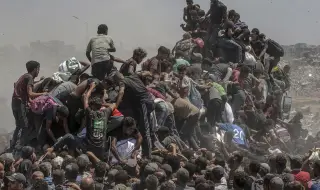
The consequences of the lack of real peace continue to be borne primarily by Palestinian civilians. The humanitarian situation in the Gaza Strip is still dire, and in many places it is getting worse rather than better. Shortages of goods, rising prices and damaged infrastructure are making life even more difficult. Expert Fuchs describes the situation as a "downward spiral". Even when humanitarian aid is being delivered, uncertainty is still high. "The long crises and especially the deadly famine of 2025 have a long-term effect and reinforce people's sense of constant threat," explains Fuchs.
At the same time, it is difficult to get an idea of the political climate in the Gaza Strip from the outside. It seems that any disagreement with Hamas continues to be repressed, sometimes with brutal measures, says Peter Lintl. This makes it even more difficult to adequately assess the situation. At the same time, Palestinians continue to feel constantly threatened by Israel with displacement.
Peter Lintl is skeptical that any breakthrough can be achieved in the short term. The political price that both sides would have to pay is too high, he says. Structural obstacles remain.
Many international analysts share this assessment - while the ceasefire is a fact and does provide some relief for the people, it is only partially effective. A durable political solution is needed, but it is not on the horizon.
For now, the Gaza Strip seems to be stuck in a situation where it is neither at war nor at peace. This is not safe and means that a new escalation is possible at any time.
Author: Kersten Knip