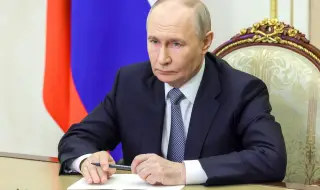
Russian President Vladimir Putin is using nuclear rhetoric and demonstrations of military power after Russia apparently failed to independently guarantee full security for the Victory Day parade without relying on a commitment from Ukrainian President Volodymyr Zelensky to temporarily cease hostilities, News.bg reports.
According to the Institute for the Study of War, Putin's emphasis on the RS-28 “Sarmat“ intercontinental ballistic missile is intended to divert public attention from the deteriorating situation of Russian forces on the battlefield, especially during the spring-summer offensive in 2026.
Analysts believe that through the test launch of the “Sarmat“ and the accompanying rhetoric Putin seeks to cover up the fact that it was Ukraine's actions, not Russia's air defense capabilities, that contributed to the smooth conduct of the parade in Moscow on May 9.
On May 12, Putin announced that the Russian armed forces had successfully tested the super-heavy intercontinental ballistic missile RS-28 "Sarmat", known in NATO classification as SS-X-29 or SS-X-30.
The Russian president emphasized the missile's long range and significant payload, while also highlighting other Russian systems with nuclear capabilities, including the medium-range ballistic missile "Oreshnik", the unmanned underwater vehicle "Poseidon" and the nuclear-powered cruise missile “Burevestnik“.
According to Putin, the first “Sarmat“ missiles will be brought into combat readiness in the 62nd missile division of the Russian Strategic Missile Forces, located in the Krasnoyarsk Territory, by the end of 2026.
According to the Institute for the Study of War, the current rhetoric around “Sarmat“ is reminiscent of the messages used by the Kremlin during the first tests of “Oreshnik“. Analysts emphasize that this show of force rather reveals political vulnerability, as Moscow was forced to rely on Ukrainian restraint during the May 9 celebrations.
Ukrainian attacks on targets deep in the Russian rear have shown the limitations of Russian defense and its inability to reliably defend key areas, including the capital Moscow.
Limited Results of the Russian Offensive and Successful Ukrainian Counterattacks
Russian forces launched their spring-summer offensive against fortified Ukrainian positions in mid-March 2026, but so far the operation has not led to significant successes from an operational point of view.
Since November 2025, Ukrainian forces have recaptured much of Kupyansk. In the winter and spring of 2026, they liberated over 400 square kilometers in the southern part of the country, and by the end of April they had regained control over several settlements in the western part of Zaporizhia Oblast.
These actions force Russia to choose between strengthening its defenses against Ukrainian counterattacks and transferring resources to the most important sections of the front. According to analysts, this creates serious difficulties for Putin's strategy, which relies on the impression that Russian forces are advancing in all directions and are close to breaking through Ukrainian defenses.
In reality, Ukrainian defense lines remain resilient, and the Ukrainian army manages to challenge the tactical initiative in a number of areas, while Russia continues to suffer significant human losses for minimal territorial gains.
First death of a student recruited into the Russian combat drone forces confirmed
According to data from open sources, the first death of a Russian student recruited into the newly created Russian unmanned systems forces has been confirmed.
This is Valery Averin, who signed a contract with the army in January 2026. On March 24, he completed his training as a combat drone operator. His last conversation with his mother was on April 2, and he died in combat on April 8.
Averin's mother told the BBC Russian Service that she knew of another student who had died on the front.
Russian authorities announced that Averin was killed in the Luhansk region.
The Russian Defense Ministry has launched a campaign to recruit Russian students to combat drone units in January 2026.
This initiative is part of efforts for covert mobilization against the backdrop of declining interest in military service and increasing casualties.
Russian military bloggers have already criticized the effectiveness of the campaign and warned that some of the recruited students may be sent directly to the front line.