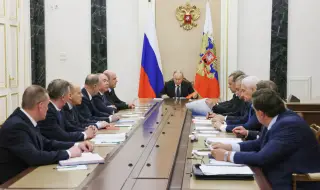
Russian President Vladimir Putin heard two opposing visions of Russia's future at his main annual investment conference on Wednesday, amid the war in Ukraine that continues in full force, Reuters reported, BTA writes.
Some participants in the prestigious St. Petersburg International Economic Forum said that Russia must continue to fight and prepare for a global confrontation with the West.
Others stressed the economic benefits that could be derived from ending the war, which almost reached the forum's threshold when Ukrainian drones struck an oil terminal and naval base in St. Petersburg on Wednesday, sending smoke billowing over parts of the city.
The contrasting narratives illustrate the debates taking place among political and business circles leaders on what Russia can expect in the future, as well as what internal factors are influencing Putin after more than four years of war in Ukraine.
Putin's deputy chief of staff, Maxim Oreshkin, told the conference that it was pointless to expect a return to the old days or the lifting of sanctions by the West. “You shouldn't wait for something to change, for something to return; "It won't come back and it won't change," Oreshkin said.
BALANCING BETWEEN WARRING FACTIONS
The 73-year-old Putin has long ruled by balancing the interests of different factions in the Kremlin, all of whom are vying for influence over the man who has been Russia's supreme leader for the past quarter century.
Signs that Russia's $3 trillion economy is stagnating as the war drags on have fueled arguments among some in the "elite" that the war should end and a peace brokered by U.S. President Donald Trump be made.
Some nationalists, however, see the war simply as the first stage of a much deeper global confrontation with what they see as a declining West, meaning years - or even decades - of possible world war. war.
“We have to admit that we will be at war for the next few years, maybe for several decades“, said Andrei Bezrukov, a former spy arrested by the Federal Bureau of Investigation (FBI) in 2010 while living under a false identity in the United States.
“It could be a very fierce war, it could be a gradually escalating war. Even if it spreads to other regions, we will have two generations who will practically live in a state of war. "And we must learn to live with this war," Bezrukov said to applause from the packed hall.
The nationalists said Russia must get back into shape or face potential collapse and ruin.
Among the ideas proposed by the nationalists at the conference, often presented as Russia's answer to the World Economic Forum in Davos, were streamlining the decision-making process, developing technology and changing the perception of the Russian army in Russian society.
WEAPONS ON DISPLAY
The pavilions that were once visited annually by financiers from Western companies - such as the American investment bank „Goldman Sachs“ („Goldman Sachs“) - Drones and weapons were on display, and cyber firms touted facial recognition technology and advanced cyber defense programs using artificial intelligence.
Russia controls about a fifth of Ukrainian territory after Putin decided to send tens of thousands of troops in February 2022. But its advance on the battlefield has slowed this year.
Russian forces captured most of the Donbas in eastern Ukraine in fighting that began there in 2014, but have failed to capture the remaining 10 percent or so.
Ukraine says it will not withdraw its forces from the part of Donbas it still controls and that it will never recognize Russian sovereignty over Ukrainian territory that Moscow has seized. Russia initially aimed to control all of Ukraine.
Peace talks, brokered by the United States, remain stalled, with Russian Foreign Ministry spokeswoman Maria Zakharova saying Washington was “unfortunately” now paying less attention to them because of the Iran crisis.
Several prominent figures in Russia have tried in the past to warn Putin of the growing economic costs of the war.
As Ukrainian drones and missiles attack Russian oil facilities and military-industrial sites, Kirill Dmitriev — Moscow’s key man in dealings with the Trump administration — has touted the potential economic benefits of a peace deal.
“The question is: will this war end or is there a much more difficult future ahead?“, a Russian participant in the event told Reuters, speaking on condition of anonymity due to the sensitivity of the issue.
Putin has insisted that Moscow has no intention of attacking NATO, whose member states have a combined economic power many times greater than Russia's, even though Russia is the world's largest supplier of natural resources.
However, ultranationalist Russian ideologue Alexander Dugin, whose daughter Daria was killed in a car bomb explosion in 2022 that Moscow has blamed on Ukraine, told reporters that the war in Ukraine “will either end with a Russian victory or it will never end“.
“We must gather all our strength, muster all our will and stop pretending to be peaceful a country that goes to barbecues or summer vacations,“ he said.
Dugin said Russia would not attack the West. However, when asked to summarize Russia's relations with the West in the coming years, he replied simply: “War“.