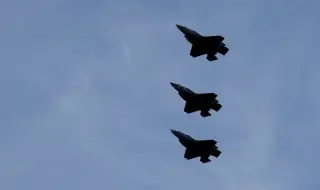
China has carefully studied American stealth aircraft, but has drawn the wrong conclusions about the reasons for their effectiveness. This opinion is expressed by US Air Force Major Derek Eklebe in a study published this month by the US Air Force Institute for the Study of the Chinese Aerospace Industry, Defense News reports.
The publication notes that Beijing simultaneously admires the capabilities of American stealth aviation and fears it. That is why China has invested significant resources both in creating its own low-observability aircraft and in developing systems to counter such air platforms.
However, as Eklebe argues, Chinese military analysts misinterpret the basis of American success. According to them, technology plays a key role, while in the United States stealth technology is viewed as only one element of a broader concept of conducting air warfare.
"The Chinese side's assessments of stealth technologies often differ from the technical reality and the practice of their operational use", emphasizes Eklebe.
According to the expert, the US military perceives stealth as a complex opportunity, combining technology, tactics and methods of using forces in order to maintain air superiority. That is why technological solutions alone do not guarantee success.
The article states that China is responding to American stealth capabilities in two directions: actively developing multi-layered air defense and accelerating the creation of its own aircraft with reduced observability. Since Chinese experts consider technology to be a key factor in the effectiveness of American aircraft, they are convinced that countermeasures against them must be primarily technological.
That is why China is investing in the development of low-frequency radars, passive sensors and other detection means. However, according to Eklebe, many of these solutions have either not yet proven their effectiveness or have significant limitations.
At the same time, the author of the study warns against underestimating China's air defense. Its strength lies not in individual radars or missiles, but in the integration of various means into a single air defense system. The Chinese army combines data from early warning radars, passive detectors and even satellites in common command centers.
A similar approach, according to Eklebe, is also observed with Chinese stealth aircraft. In particular, the J-35 fighter is largely reminiscent of the American F-35, but relies on hardware characteristics, rather than software flexibility and modernization of tactics for use.
The expert also suggests that China's assessments of American aviation may be distorted by the Chinese aircraft's own problems, in particular, difficulties with engine reliability. Therefore, Chinese strategists may mistakenly project the shortcomings of their equipment onto American systems.
According to Eklebe, this misperception may have negative consequences for security in the Asia-Pacific region. If the Chinese leadership becomes convinced that modern sensors are capable of neutralizing the advantages of American stealth aviation, this may prompt it to take more risky and aggressive actions towards Taiwan.
“Chinese strategists seem to view stealth technology not as an insurmountable obstacle, but as a factor that can be neutralized with the help of superior forces and integrated networks,“ the researcher concludes.