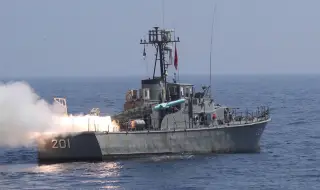
Tensions in the Middle East have sharply escalated and the US and Iran have again started exchanging air strikes, with Tehran stating that all diplomatic efforts to end the conflict over the past few months have been pointless.
The renewal of hostilities and their consequences for both the region and the rest of the world are among the main topics in the British and American press today.
Great Britain
After the clashes between the US and Iran escalated for a week, the Islamic Republic took a risky step and announced that it had closed the Strait of Hormuz, writes the British newspaper "Financial Times".
At the same time, Iran launched the largest wave of missile and drone strikes in recent weeks, targeting US-allied Arab states - Bahrain, Kuwait, Jordan, Qatar and Oman.
This represents the most serious test yet of the fragile ceasefire that took effect on April 8. The strikes also reflect Iran's frustration with US attempts to weaken its influence in the Strait of Hormuz and the belligerent attitudes in Tehran that have been fueled by the two wars the US and Israel have waged against the Islamic Republic in the past year.
"They are taking risks. Their goal is self-preservation and preventing the erosion of the influence they believe they have," said Sanam Vakil, director of the Middle East and North Africa program at the US think tank "Chatham House". "They still believe that Trump is not willing to risk that they can withstand a low-intensity conflict and exhaust the US. But this leads to stagnation", Vakil added.
According to Vakil, however, there is a risk that the escalating exchange of blows could push the region back towards full-scale conflict.
"The renewal of the exchange of threats and blows between the US and Iran and the fruitless search for a way out of the war through escalation is a familiar cycle, but this fact should not overshadow the consequences," writes the British newspaper "The Guardian".
Tehran said yesterday that it had closed the Strait of Hormuz again. The World Food Program is feeding 1.5 million fewer people this year because of the war started by the US and Israel. Vulnerable countries are suffering the most from the deepening crises: another 2.5 million people in Somalia and 2.3 million in Afghanistan are barely able to meet their basic food needs, the British publication continues.
The humanitarian crisis is unlikely to be averted even with de-escalation.
The full impact of the conflict on food production is yet to be felt, but the Strait of Hormuz is crucial for global fertilizer exports, and rising prices have hit many farmers. In addition, a drop in remittances from migrants working in the Gulf has hit a number of countries in Asia and Africa hard, the Guardian newspaper lists.
Thousands of people have been killed in Iran and Lebanon, including civilians, many of them children. Vital infrastructure has been destroyed. The Iranians are increasingly approaching economic catastrophe, and under the guise of war, the regime is taking increasingly strict restrictive measures, the British newspaper continues.
Tehran's retaliatory strikes have caused death and destruction across the region. Energy and food prices are rising for consumers around the world.
Ending the war depends on resolving the main problem that the conflict has created - Iranian control of the strait, the "Guardian" also writes.
The immediate priority must be to facilitate humanitarian supplies.
Oman and other countries are trying to find a way out of the crisis, which the countries that caused it could not find. One proposal was to allow the collection of navigation fees, but on a voluntary basis and under the auspices of a UN body. This idea has potential, although for a militarized and more hard-line regime the levers of control are probably more significant than the profit, the British publication notes.
But none of the warring parties can achieve a decisive victory, neither of them wants an open end to the war, nor to make the necessary concessions. And the rest of the world must try to reason with them or live with the consequences, the Guardian concludes.
USA
For two months, under an unannounced public agreement with the US Navy, commercial tankers turned off their transponders to avoid being detected by Iran as they crossed the dangerous Strait of Hormuz and delivered oil and gas around the world, the New York Times writes.
The US military provided some air cover in case of Iranian attacks, while naval officers radioed ships to keep course off the coast of Oman. This allowed for a gradual increase in traffic through the strait from May to June, the American publication continues.
But the framework agreement signed by Trump last month to end the war contributed to the dramatic end of that initiative. The reason is that the wording of the agreement gave Iran formal authority in the Strait of Hormuz, and some key phrases sounded too vague, the publication believes.
Trump hailed the framework agreement signed on June 14 as a tool with which the prophet opens.
"Ships of the world, start your engines… Let the oil flow! ”, the American leader wrote on his social network Truth Social.
Some critics say that the framework agreement actually legitimized a reality that Iranian authorities have clearly indicated throughout the war: that they control the Strait of Hormuz.
After the US and Israel attacked the Islamic Republic, the Iranian military launched air strikes against merchant ships in the Strait of Hormuz, effectively blocking it. And a few weeks after the temporary and unofficial ceasefire concluded in April, some tankers began using a southern route further away from the Iranian coast to pass through the strait.
In the midst of the war, however, some shipowners preferred to sail closer to Iran - and rely on the guarantee of safe passage given by the Iranian armed forces. Iran announced that fees of up to $2 million per vessel would have to be paid.
Last week, Iran launched strikes in the southern route area, trying to force ships to pass through its territorial waters.
Tehran has said that all ships passing through the strait must follow this route after receiving permission from Iranian authorities.
But as Iran and the United States fight for influence, primarily through military means, the risks for shipping companies could increase, he told the "New York Times" Dan Alamariu, chief geopolitical strategist at investment research firm Alpine Macro.
Iran has suffered economic losses, but it may be ready to take more.
"The question is which will collapse first: the Iranian economy or the global economy," Alamariu concluded.