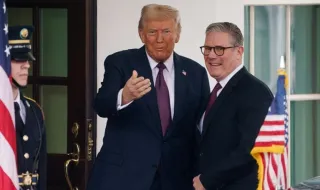
Donald Trump has hinted that he would not support Britain if Argentina invaded the Falklands again. The US president joked in an interview with GB News that the UK was "not doing a good job" and had failed to "help" with the military campaign against Iran.
The comments came as "fiery" Argentine President Javier Milley - a close ally of Trump - prepares to make a televised address on the "sacred" the disputed archipelago.
The US has traditionally taken a neutral stance on the Falkland Islands, which Argentina calls the Islas Malvinas.
But the US president has recently hinted that position is being reconsidered, in what many see as a pressure tactic to get more military cooperation from the UK.
When asked in an interview with GB News on Thursday whether he would "come to the aid" of the UK in the event of another invasion, Trump said he clearly remembered the 1982 conflict.
"I was there when the first war happened, that was a long time ago... you did very well, you got them back very quickly. But they are far away," he said.
"So your country is not doing well. "Remember, you get a large percentage of your oil from the Strait of Hormuz and you weren't there to help me. Your country wasn't there to help me," the US president said.
During Keir Starmer's premiership, the UK initially refused to participate in the US-Israeli offensive against Iran.
Sir Keir later authorised forces to support "defensive" strikes against targets such as missile launchers.
However, the UK has not agreed to Trump's call to send naval forces to reopen the Strait of Hormuz. A fifth of the world's oil and gas supplies normally pass through the waterway, but Iran has blocked it in response to the attacks.
A furious Trump called Keir Starmer "un-Churchill" and insisted he had rejected a British offer to send an aircraft carrier to the region because it came too late. Ministers denied that any such proposal had been made.
The UK government is adamant that the sovereignty of the Falkland Islands is not in doubt. In a 2013 referendum, islanders voted 99.8% to remain British subjects, with a voter turnout of 92%.
Argentine forces attempted to seize control of the Falkland Islands in 1982, prompting then-British Prime Minister Margaret Thatcher to send a naval task force to retake them.
The war left 649 Argentines, 255 Britons and three islanders dead.
In his post on Monday, Millay scheduled a televised address on Thursday night on "A SACRED QUESTION FOR ARGENTINANS: THE CAUSE OF THE MALVINES".
"What cause is more important and strategic to the vital interests of the nation than the cause of the Malvinas?" - he wrote.
The Falklands tensions could become a worrying backdrop to Andy Burnham's first meeting with Trump.
The prime minister said he was likely to head to New York later this month to attend the UN General Assembly.
He offered to lobby the president for greater support for Ukraine, although it is not clear whether Trump will be in New York or Burnham will make another stop in Washington.
Another threat to the UK's sovereignty over the Falklands comes in the form of a lawsuit announced by Argentine groups on Tuesday to halt a British-Israeli oil project off the coast.
The so-called "Sea Lion" oil field includes Britain's Rockhopper Exploration and Israel's Navitas Petroleum, which are seeking to establish a large-scale oil operation about 137 miles from the Falkland Islands, according to war veterans and environmental lawyers suing to stop the project.
The project violates a United Nations resolution that states that unilateral actions should be avoided while a territorial dispute is ongoing, the plaintiffs insist.
Although the project is taking place in a British-controlled area, they argue that a decision by local courts could affect its progress.
The complaint aims to ensure that the companies "will refrain from starting and/or continuing work... as well as from starting the extraction and exploitation of hydrocarbons," lawyer Enrique Viale told AFP.
The Falkland Islands issue remains a sore point for many Argentines.
During the World Cup semi-final against England in July, some Argentine players held up a banner reading "Las Malvinas son Argentinas" after beating their opponents 2-1.
Following the demonstration, a Downing Street spokesman responded: "The World Cup may not be ours, but the Falklands definitely are".