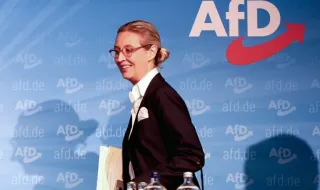
The far-right “Alternative for Germany“ (AfD) declared victory in Saxony-Anhalt, but failed to secure a majority of seats in the eastern German state's regional parliament, BTA reports.
The AfD won yesterday's election with 43.8% of the vote, ahead of the conservative Christian Democratic Union (CDU), which received 17.2%, according to results from early this morning. This is the CDU's weakest result in an election in Saxony-Anhalt in the party's history.
Three left-wing parties – “The Left“, “The Greens“ and the German Social Democratic Party (SPD) – passed the 5% threshold, each receiving around 9% of the vote.
The populist Alliance “Sarah Wagenknecht“ also passed the 5% threshold and entered the state parliament. The pro-business Free Democratic Party (FDP) received 2.6% of the vote and failed to reach the required threshold.
The voter turnout reached almost 78% according to preliminary results – the highest in Saxony-Anhalt since German reunification in 1990.
Despite the AfD's election victory, it is still unclear who will lead the next government in Saxony-Anhalt, as the main German parties refuse to cooperate with it – a policy known as the “firewall”, the DPA reported.
After the results were published last night According to the first exit polls, AfD leader Ulrich Sigmund said voters had given the party a "mandate to govern", and its co-chair Tino Krupala said the 35-year-old politician "will be the new prime minister of Saxony-Anhalt".
The current three-party coalition led by state premier Sven Schulze of the CDU is impossible, as the FDP remains below the 5 percent threshold. Schulze could try to form a new governing coalition, but that would depend on the votes of the "Left" - a party with which the CDU has so far refused to cooperate.
The AfD could try to form a minority government, and Sigmund allowed for the possibility that other MPs could decide to join his party in the state parliament, hinting at separate votes in the CDU, which insists that the “protective wall“ against the AfD be removed.
The victory puts a far-right party on the verge of power at the provincial level for the first time in Germany since the end of World War II, Reuters notes.
While it falls short of an absolute majority, the result of around 44% is a heavy blow to Chancellor Friedrich Merz's conservatives and reflects the deep unpopularity of Germany's ruling coalition against the backdrop of an increasingly fragmented political landscape, the agency points out.
The AfD is already the most popular party in Germany at the national level and is seeking to secure real power from which to push its political agenda. Among its main positions are strongly restricting immigration, restoring relations with Russia, reducing support for Ukraine and Germany's exit from the eurozone.
“We are entering the history of this country”, said Ulrich Sigmund.
The 35-year-old AfD front-runner has drawn thousands to his campaign rallies and has repeatedly touted a possible victory in Saxony-Anhalt as a first step towards winning national power in the 2029 federal election.
“The people have made it very clear that they finally want political change and above all they have shown that they want this change with us,“ Sigmund said.
When the first exit polls were announced, he stood in an embrace with the party's two national co-chairs, who laughed with joy as the scale of the victory became clear, Reuters reports. At the AfD campaign headquarters in Magdeburg, wild celebrations erupted, with supporters waving German flags and hugging each other.
US President Donald Trump posted a photo of the results on his social media account Truth Social without comment, and leaders of far-right parties in other European countries welcomed the result as a mandate for change.
For Chancellor Merz, the election represents a serious political setback. His personal approval rating has fallen to historic lows, while voters distance themselves from both his planned reforms to revive the struggling German economy and his public style, marked by a series of gaffes, Reuters reported.
A survey by ADR television shows that 87% of voters in Saxony-Anhalt are dissatisfied with the federal government. Sigmund even described Merz as the AfD's "best campaign agitator" precisely because of his unpopularity in the province.
“This election result is above all a vote of no confidence in the federal government“, Marcel Fratzscher, president of the German Institute for Economic Research, told Reuters.
Merz has pledged to revive Europe's largest economy through business-friendly reforms and increased spending. Before the election, the chancellor warned that an AfD victory in Saxony-Anhalt would hurt the state and deter foreign companies from investing there.
Germany's main parties continue to refuse to cooperate with the AfD, which is classified as far-right by the local German domestic intelligence service.
One exception to the categorical rejection of any interaction with the AfD is the “Sarah Wagenknecht“ Union. The party proposed that Saxony-Anhalt be governed by a non-partisan prime minister who would rely on shifting majorities in parliament, including votes from the AfD.
Sigmund dismissed the idea as “mess” and ruled out agreements with other parties that would prevent the AfD from fulfilling its promise of political change.
“If it comes to that, there will simply be new elections,“ he said.
The CDU has said it will explore the possibility of talks with other political forces, although such a government could require parties with very different political agendas to come together.
In the neighboring eastern German state of Thuringia, the conservatives are in a minority government that enjoys the passive support of the “Left“.
Although Saxony-Anhalt, which was part of the former German Democratic Republic, is one of Germany's smaller states with a population of just over 2 million, the election result highlights the AfD's rapid progress since its founding in 2013.
According to a recent survey by the INSA institute, the party now has the support of 28 percent of Germans at the national level - significantly more than the 20 percent for the conservatives.
Far-right parties are also gaining support in other parts of Europe, but Germany's Nazi past has so far been an additional reason for the country's main political forces to refuse to cooperate with the AfD.
The party itself rejects accusations of extremism as an attempt to intimidate and an insult to its millions of supporters.
During the campaign, the AfD has capitalized on growing disillusionment with traditional parties, which it portrays as tired and disconnected from society, Reuters notes. The party counters them with a series of hard-line policies and a nostalgic vision of a return to cleaner and safer streets and a stronger sense of pride in German nationality.
„It is clear that we need change in Germany and in Western Europe. And I think that this is definitely the starting signal -– "whether you like it or not," Anthony Lee, who attended the AfD election party, told Reuters. "I'm a father, I'm an entrepreneur and I know that things in Germany cannot continue like this," he added.
The AfD's program calls for schools and cultural institutions to be geared towards what the party describes as more traditional values, as well as a crackdown on immigration and a major overhaul of public broadcasting.
The party wants refugee children to be taught in separate classes. It wants rainbow flags banned in schools and the German national flag flown every day. The national anthem should be sung by students and teachers at school celebrations.
Other proposals include the creation of civic patrols, more Russian language instruction in schools and a halt to the construction of new wind farms.
According to the preliminary distribution of seats cited by AFP, the AfD will have 39 deputies - just three short of the one needed for an absolute majority in the provincial parliament.
This opens a period of complex political negotiations. To reach its own majority, the AfD would have to attract MPs from other parties, for example from the CDU, or find some form of situational cooperation with the "Sarah Wagenknecht" Alliance, which according to the ADR and the CSD receives four parliamentary seats and does not rule out cooperation on individual issues.
No German state has been governed by the far right since 1945.
"Of course we have a mandate to govern," Sigmund told his supporters in Magdeburg, the capital of a former GDR state with 2.1 million inhabitants.
He added that he "reaches out a hand" to anyone who “wants to solve the main problems of this province together with us“.
The national co-chair of the AfD, Alice Weidel, also called on “the CDU or part of the CDU“ to turn to her party.
The CDU continues to officially rule out such an alliance, but according to AFP, the scale of the defeat could reignite debate within the party, as some of its representatives have long been pushing for a rapprochement with the AfD.
Vice Chancellor and SPD co-chair Lars Klingbeil described the heavy election result as a “signal to Berlin“ that should make the government “consider the path of reforms they have taken”, he told Zet DF.
Chancellor Merz did not immediately react after the results were announced and is expected to speak today after a CDU meeting.
French European Affairs Minister Benjamin Haddad also reacted to the result. "It is a difficult moment for Europe to see the far right win regional elections in Germany," he wrote in Ex, quoted by AFP.
The agency also described the atmosphere at AfD headquarters in Magdeburg, where party supporters cheered when the results came in.
“I always prefer to be a little pessimistic in advance so that I can be pleasantly surprised afterwards. "And that's exactly what happened today," 65-year-old pensioner Angela Maike told AFP as she ordered two beers and a glass of red wine to celebrate the result. If given the chance to govern, Sigmund has promised to significantly increase the expulsion of foreigners, change history programs that he says place too much emphasis on Germany's guilt for the Third Reich, and remove the province from the current public radio and television system, which the AfD sees as biased against the party. "Personally, I am shocked by the result of this election," he told the Welt newspaper. the chairman of the Central Council of Jews in Germany, Josef Schuster.
AFP also draws attention to Sigmund's strong presence on social media and the way he exploits nostalgia for the former GDR among some of his voters, who feel disadvantaged compared to Germans from the west of the country and migrants.
Yesterday, Sigmund arrived to vote with his wife Julia with “Simson“ – an iconic moped from the former East Germany.
“He is really very good and close to ordinary people, he goes to the people, gives everyone a say or listens“, 56-year-old maintenance worker Peter Harmuth told AFP.
For the conservatives, the defeat was particularly heavy, with their result roughly half lower than in the 2021 election.
Holger Schmieding, an analyst at the Berenberg bank, predicted to AFP a “period of serious and potentially turbulent introspection“ for the CDU.
Merz came to power in May 2025 with a program to tighten migration policy, through which he hoped to limit the drain of votes to the AfD. But the chancellor is currently at his lowest approval rating amid a weak economy and disputes with his Social Democratic partners, AFP noted.
The prime minister of Saxony-Anhalt, Sven Schulze, acknowledged his heavy defeat and congratulated the winner.
"The voters sent a clear message," he said, urging leaders at both the state and national levels to "fully understand the significance of this signal."
Additional police were deployed in Magdeburg amid fears of clashes between AfD supporters and opponents. Metal barriers were erected around the Landtag - the state parliament - and heavy police patrolled the area.