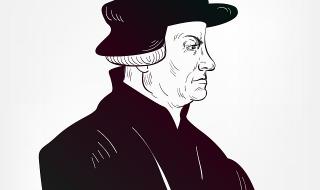
On October 11, 1531, the Swiss reformer Ulrich Zwingli dies in a battle at Kappel. This takes place during the second war on a religious basis between the Swiss Protestant and Catholic cantons.
Unlike Martin Luther, Ulrich Zwingli seeks to give a more rational explanation of some Christian rites. He carries out a reform of the church and political organization in Zurich. He subordinates the church to the city authorities, prohibits military mercenaries. He makes efforts to create a Christian church with a republican organization.
Ulrich Zwingli was born on January 1, 1484 in the canton of St. Gallen into a wealthy peasant family. He studied at the school of classical languages and at the universities of Vienna and Basel. In 1506 he became a master of philosophy. His views were formed under the strong influence of Renaissance thinking and humanism. He was impressed by the Platonism of the Florentine School, especially Marsilio Ficino. He communicated with Erasmus of Rotterdam. The Holy Scripture was the subject of his special intellectual interest and in order to be able to reach its authentic messages, he studied Hebrew.
For some time he was a priest in a parish in Glarus. Since 1518 he has held a priestly position in the cathedral in Zurich. The reforms he undertakes are inspired exclusively by the models of Christian life. According to him, Scripture is and should be the basis of both the principles of faith and Christian life. He adheres to specific views and principles bequeathed by the Apostle Paul. In many ways, his reforms were similar to those of Martin Luther, but he implemented his vision and decision about them independently and independently of Luther. He categorically opposed the sale of indulgences, and thanks to his influence in Zurich, it was discontinued. The privileged position of the Catholic clergy caused his dissatisfaction, but unlike Luther, he did not accept the possibility of the church being under the jurisdiction of a secular ruler - in his opinion, it should be built in accordance with republican and democratic principles. He believed that the priesthood did not have a gift of grace, that the mission of the clergy was preaching and educational, not mediating.
He believed that the taxes of the Roman Catholic Church were being abused and the funds were being used for unnecessary luxury. He managed to impose secularization of the properties of the monasteries in the Zurich area and created educational centers and hospices in them. According to him, monastic life was not prescribed by the Bible and was unnecessary. In his sermons, he spoke out against military mercenary service and for the political non-involvement of the Swiss cantons with other countries.
According to his decision, the fasts related to the religious calendar were abolished. He declared himself against the celibacy of the clergy. The worship in the religious community led by Zwingli was simplified. Since 1524, they have not celebrated masses, unlike the Lutherans. Saints are not recognized as mediators in communication with God. The veneration of icons and relics is abolished. All believers receive both types of communion - with bread and wine. According to Zwingli, the actual flesh and blood of Christ are not received in communion, it has rather the meaning of remembering the sacrifice of Christ. Thus, it essentially loses its meaning as a sacrament in the Zwinglian church.
Thanks primarily to the influence of Zwingli, this form of Protestantism was accepted in several more cantons - in Bern (with the decisive assistance of Zwingli's associate Heinrich Bullinger), in Basel, in Schaffhausen, in St. Gallen and in Glarus, as well as in German cities (the center of these reforms here was Konstanz). It was categorically not accepted by cantons that were forest-mountainous - Schwyz, Uri, Unterwalden, Lucerne and Valais remained faithful to the Roman Catholic Church. The differences in the policies of the urban and forest cantons became the cause of a civil war, Zwingli was motivated by the idea of organizing a stable federation of Protestant cantons and led a battle against the Catholic ones. The union of the forest cantons was supported by Catholic Austria. He himself became a victim of this civil war - he was killed in the unsuccessful battle of Kappel for Zurich.
Zwingli's work was continued by his associate Heinrich Bullinger.