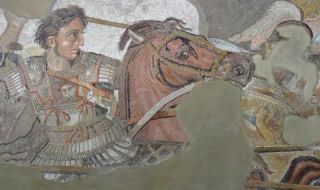
On June 13, 323 BC. in Babylon, under mysterious circumstances, one of the greatest military leaders in world history died - Alexander III of Macedon, son of Philip II.
In about 10 years, Alexander managed to conquer the lands from the Balkans to India, destroy the Persian Empire, lay hands on Egypt and Mesopotamia and lay the foundation for a whole new period in the history of the Eastern Mediterranean - Hellenism.
Alexander was born in 356. His mother, the Epirus Olympias, claimed that his real father was not Philip, but Zeus, and thus created a divine halo around her son.
He inherited the throne in 336. BC, when Philip was killed during the marriage of his daughter Cleopatra to an Epirus chieftain. Having quickly secured control of Greece, Alexander set out for Persia. At the head of 40,000 soldiers in 334, he crossed the Hellespont (modern Dardanelles), defeated the Persians at the Granicus River, and established control over the Greek cities of Asia Minor.
In 333, he defeated the Persians again at Issa, then set out for Egypt. In 331, the Persian Empire was finally defeated after the Battle of Gaugamela, and Alexander laid hands on Assyria and Mesopotamia.
Over the next few years, Alexander's armies continued their march into Bactria, modern Central Asia, and reached India. There, however, his troops mutinied and the conqueror was forced to retreat. Shortly after returning to Babylon, which he had declared the capital of his empire, Alexander died.
The vast state that emerged as a result of the conquests stretched from the western coast of the Balkan Peninsula to India, including the Petrechie. In the north, it partially approached the Danube and bordered the Black Sea, in the south it reached the Indian Ocean, the Arabian Peninsula — in Asia, and included Egypt, Libya and Cyrenaica — in Africa. In size, it exceeded the Persian state. Its population was diverse and multilingual and was at different stages of economic development. Along with highly developed countries, such as Greece, Syria and Phoenicia, Babylonia and Egypt, the state of Alexander the Great included vast territories whose population was only beginning to experience the collapse of the primitive communal system. The economic and cultural ties between the individual regions were fragile. The entire monarchy was held in subjection only by force of arms.
Alexander did not change the local forms of government customary for the population. He also left the Persian administrative division into satrapies, but usually limited the satraps, depriving them of the right to command troops and manage finances.
Alexander's real support was the army, whose social and ethnic composition during the eastern campaigns changed significantly - there were few Macedonian warriors in it, but the number of mercenaries - Greeks and from the local Asian population - increased. Alexander organized a special thirty-thousand-strong detachment of Persian youths to train them in the Macedonian art of war.
Alexander took special measures to bring his Macedonian and Greek warriors closer to the local population. A lavish wedding feast was organized in Susa, during which 10,000 weddings of Macedonian warriors with Persian and other local women were performed. He himself also married two Persian princesses at once - the daughter of Darius III and the daughter of his predecessor Artaxerxes III Ox. The marriage to the daughters of the two previous Persian kings was supposed to further strengthen Alexander's right as their heir. The Bactrian Roxana also continued to remain queen - the wife of Alexander, who thus officially had three wives.
He ordered his nobles and generals to marry noble Persian, Bactrian and Sogdian women. In one day, 80 weddings were performed. With such naive measures, Alexander tried to merge conquerors and conquered. It should not be forgotten that for many Greeks and Macedonians, including his famous teacher Aristotle, all the peoples conquered by Alexander were "barbarians", slaves by nature, etc. It must be admitted that Alexander, a pupil of Aristotle, after being faced with the practical problem of strengthening his vast and diverse state, managed to overcome this ideological limitation.
Alexander founded new cities and fortresses with a mixed Greek-Macedonian local population on the trade and strategic routes. He gave the inhabitants of these cities certain privileges. These were the fulcrums of his power in the conquered territories. There are known cases when Alexander gave the cities land with a local peasant population, so that the citizens could exploit it. The highest positions in his state were held by representatives of both the Macedonian and the local aristocracy. More or less privileged citizens lived in the newly established cities. Alexander's monarchy was supported by priests of various religions, to whom the king treated very favorably. At his court, services were performed to both the Greek and the numerous local gods. Alexander himself, declared at the time by the Egyptian priests to be the son of Ammon, striving to strengthen his state, increasingly emphasized that he was a deity, and announced this to the Greeks through the council of the Hellenic League in Corinth, wishing that they also officially recognize him as a god. The Greek cities carried out his order. In Athens, the powerless protest against this act was expressed in ironic form by Demosthenes, who had returned to the city at that time, by recommending to the national assembly to consider Alexander, “if he wishes, the son of Zeus or also of Poseidon”.
A grandiose redistribution of property took place and continued to take place in the vast expanses of Alexander's empire. A large part of the Persian treasury, which had previously been in the form of treasures or used for military and administrative needs, was put into commercial and economic circulation. Trade relations strengthened, civil life revived. Alexander centralized the issuance of gold and silver coins and minted them in huge quantities, basing his coinage on the Athenian coinage system. Alexander's state combined the Eastern and Greco-Macedonian experience. But Greece and Macedonia were a negligible part of his monarchy. Instead of "transferring happiness from Asia to Greece", as Isocrates had called for in the past, the conquest of the East by the Macedonians and Greeks led to increased emigration of the indigenous Greek population to the conquered territories. Greece and Macedonia faced the danger of becoming the periphery of the new Eastern monarchy.
Opposition to Alexander's policies was also growing among the rank and file of the Macedonian part of his army. An uprising broke out in the small city of Opis, which was located east of the Tigris River. When Alexander arrived in 324 BC e. in Opis, to announce to the army stationed there that he was sending the elderly and sick veterans and in general all those who wished to return to Macedonia with rich gifts, the soldiers staged a revolt. They said that they would all go to Macedonia, and the king should fight alone with the help of "his father" Amon. Alexander punished several of the most active of the rebel soldiers with death. As a result of the subsequent negotiations, he was forced to release about 10,000 soldiers into his homeland and to an even greater extent to use the services of the Persians.
In 323 BC Alexander arrived in Babylon, located approximately in the center of his state, at the crossroads of trade and strategic routes. He made this largest ancient Eastern city his capital. Here in the summer of 323 BC During a feast, Alexander felt unwell and after several days of illness, probably a malignant fever, or possibly poisoning, he died at the age of about 33.