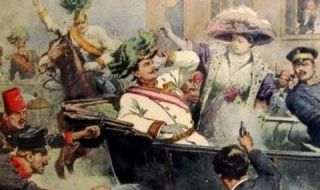
On June 28, 1914, Gavrilo Princip assassinated the heir to the throne of Austria-Hungary, Franz Ferdinand, and his wife in Sarajevo.
Princip's goal was to free Bosnia from the rule of the Austrian emperor and create an independent Yugoslav state. And the assassination was the means to achieve this goal.
The 19-year-old student Gavrilo Princip was a Bosnian Serb. He was a member of the organization "Young Bosnia", which wanted unification with Serbia. The Archduke's driver veered off the road, stopped, and caused a traffic jam. Gavrilo Princip was among the onlookers. He shot Franz Ferdinand with two shots.
During interrogation, the young man stated that the assassination was not ordered by Belgrade, but was an independent action. The man who pulled the trigger of World War I died of tuberculosis in prison in 1918. His death occurred 8 months before the end of the large-scale conflict that claimed the lives of 10 million people.
After the assassination, the Austro-Hungarian Council of Ministers decided to issue Serbia an unacceptable ultimatum, after whose rejection to resort to military force. The war began only 37 days later, and the German Kaiser Wilhelm II promised Vienna military support in the event of an attack on Serbia.
Only a few days later, Russia, France and Great Britain also joined the war. "The great powers weighed the risks and the potential benefits and ultimately decided in favor of war," says historian Christopher Clark. For this reason, the Sarajevo bombing is often cited as the spark that ignited the global conflagration, rather than as the cause of World War I.
Princip's birthplace in Obljaj was destroyed.