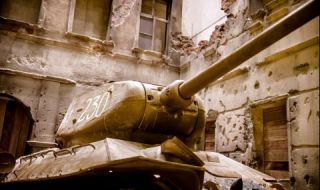
On June 29, 1944, the Red Army captured Bobruisk, killing over 20,000 German soldiers. The fighting was part of Operation "Bagration". This was the code name for the Belarusian Strategic Offensive Operation, conducted by the Red Army between June 22 and August 19, 1944. It was one of the largest military operations in the history of mankind. It was named in honor of the Georgian prince and Russian commander who became famous in the Franco-Russian "Fatherland" War. War of 1812, General Pyotr Bagration, mortally wounded at the Battle of Borodino.
The Bobruisk Operation began on 23 June against the 9th Army on the southern flank of the 1st Belorussian Front, but Russian forces suffered heavy losses before breaking through the German defenses. Rokossovsky ordered additional artillery preparation and air bombardment, and launched new attacks the next day. The 3rd Army broke through the northern sector, trapping the German 35th Corps on the banks of the Berezina. The Soviet 65th Army broke through the German 41st Corps to the south, and by 27 June the two German corps were completely encircled east of Bobruisk under constant air bombardment. Some elements of the 9th Army managed to withdraw from the Bobruisk sack, but about 70,000 German soldiers were killed and captured. Bobruisk was liberated on June 29 after heavy street fighting by the First Belorussian Front.
In the course of the prolonged offensive, German troops were pushed out of Belarus and the German Army Group "Center" and three of its component armies - the 4th Army, the 3rd Panzer Army and the 9th Army - were almost completely defeated.
The preliminary stage of Operation "Bagration" symbolically began on the third anniversary of the German attack on the USSR. The Wehrmacht sacrificed entire armies, as Hitler forbade any retreat. These were Germany's greatest losses in a single operation in the entire Second World War, and it was unable to compensate for them. By the end of the operation, German troops were completely pushed out of pre-war Soviet territory and the Red Army had seized bridgeheads in Poland, East Prussia and Czechoslovakia.
The strategic goals of the operation, together with the Lviv-Sandomierz Offensive that began a little later in Ukraine, included the defeat of German troops in the central direction, a deep breakthrough in the Wehrmacht's operational and strategic defense zone, and the seizure of bridgeheads on the Vistula River in Poland, thus placing Berlin within range of the Red Army's next major offensive - the Vistula-Oder Operation.