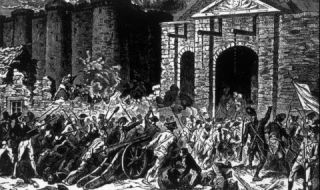
Today, France celebrates its national holiday. On this day in 1789, Parisians stormed and captured the Bastille - a medieval fortress and prison that became a symbol of despotic royal power.
At the time of the storm, there were only seven prisoners in it, but it is considered the beginning of the French Revolution and an icon of the French Republic.
The Bastille was built in 1382 as a fortification on the approaches to the capital Paris. However, it soon began to serve as a prison, mainly for political prisoners. For 400 years, quite a few celebrities have passed through the fortress-prison. Among them are La Rochefoucauld, Pierre de Beaumarchais, Marquis de Sade, Nicolas Fouquet... Francois Voltaire was twice imprisoned in the Bastille.
At the end of the 18th century, France found itself on the verge of bankruptcy. The convened States General - the highest estate-representative body - proclaimed itself the Constituent Assembly and set itself the goal of developing the constitutional foundations of a new political order, excluding absolutism.
The reason for the siege of the Bastille by the citizens of Paris was the rumors that the king intended to dissolve the Constituent Assembly. At the same time, the royal troops took up position near Paris.
On July 14, 1789 Parisians, determined to resist the royal forces, headed for the Bastille to lay hands on the weapons stored there, although it is traditionally believed that the storming was aimed at freeing the prisoners. At that time, there were only seven prisoners in the fortress, and the garrison guarding it exceeded a hundred soldiers. The storming lasted four hours, the commander of the fortress was captured, and the prisoners - released.
After June 14, the Paris city hall decided to demolish the Bastille, which happened over the next three years.
Now, on the site of the destroyed Bastille, there is the Place de la Bastille - where many streets and boulevards intersect. In the center of the square stands a column crowned with a bronze statue of the genius of liberty, the work of Auguste Rodin. In one hand he holds the torch of civilization, and in the other the broken chains of slavery.
July 14 became a national holiday in France on January 31, 1879.
On July 14 itself, a solemn military parade is held on the Champs-Élysées - it starts at 10 a.m. from the Etoile in the direction of the Louvre, and the president personally receives it. On the Place de la Concorde opposite the famous Arc de Triomphe, special stands for spectators have been erected. The finale of the holiday is the grand salute and illuminations near the Eiffel Tower and on the Champ de Mars. This real pyrotechnic show usually starts at 10 p.m.