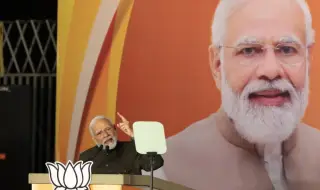
The Indian coalition "National Democratic Alliance", headed by Prime Minister Narendra Modi's party "Bharatiya Janata", leads in several exit polls, the results of which were published after the end of today's seventh and final stage of the elections for the Lok Sabha (the lower house of the Indian Parliament), reported the Indian television NDTV, quoted by BTA.
According to exit polls by five polling agencies, Modi's government will remain in power with more than 350 seats in the 543-member lower house of parliament, where 272 seats are needed for a simple majority.
So far, exit polls indicate that the opposition bloc INDIA, led by the party "Indian National Congress" (INC), will get between 125 and 150 seats.
Polling stations closed at 18:00 local time. Voter turnout is expected to exceed 60%, but official figures are not yet out.
"Today is a historic day for India," the Election Commission of India said in a press release. "The 2024 general election, the first phase of which was on April 19 and was conducted in seven phases, ended today. Indian voters have exercised their most cherished right to cast their vote for the constitution of the 18th Lok Sabha. The great Indian voters, irrespective of their caste, creed, religion, socio-economic and educational background, won again. The real winner in reality is the Indian voter," the press release also said.
Parliamentary elections in India - the most populous country in the world, with a population of more than 1.4 billion people - last a total of 44 days, making them the longest in the world. Nearly 970 million people have the right to vote - over a tenth of the Earth's population.
Of the 969 million registered voters - more than the population of the European Union and the United States combined - 18 million are eligible to vote for the first time. About 197 million are under the age of 30. 15 million people are busy with the organization and security of the electoral process.
The results are scheduled to be announced on June 4 - three days after this "gigantic exercise in democracy," as political analysts call it, ends. The election will determine the new composition of the 545-seat Lok Sabha. The people will actually vote for 543 deputies, and the remaining two will be appointed by the president.
In India, the upper house of parliament, the 245-seat Rajya Sabha (Council of States), is elected by the legislative assemblies of the 28 states and eight union territories, with 12 senators appointed by the head of state.
The vote is considered one of the most significant in Indian history. If Narendra Modi wins, he will become the second Indian leader to remain in power for three consecutive terms after Jawaharlal Nehru – the first Prime Minister to rule India.