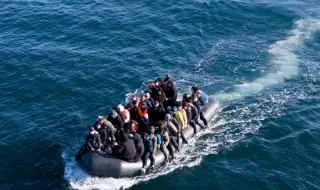
Tunisia's Prime Minister Ahmed Khachani called on European countries to increase financial aid to his and other countries to cope with the flow of migrants from sub-Saharan Africa, Reuters reported, quoted by BTA.
Tunisia has faced a number of local protests and has faced additional financial costs as migrants arrive from other countries hoping to continue to Europe by sea, risking dangerous journeys by boat.
Southern Tunisian cities such as El Amra and Jebiniana are home to thousands of migrants, many fleeing poverty and conflict in Africa and the Middle East in the hope of a better life in Europe.
"Countries like Tunisia should be given more help. The aid provided is insufficient to deal with the problem,'' Khachani told a conference on migration in Tripoli, adding that Tunisia is a victim country and is draining its public finances in its efforts to deal with the migration crisis, an additional burden for the government, which it was already facing other problems.
"There are cities that have absorbed migrants beyond their capacity," he said, referring to El Amra and Jebiniana.
In March, the European Union allocated 160 million euros to Tunisia in budget support for financial and economic stability, as part of an agreement aimed at combating illegal migration.
"For 10 or 50 years, money has been spent on this problem, but it has not been solved," Libyan Prime Minister Abdul Hamid al-Dbeyba said at the conference. "This money should be spent there (in the countries of origin) and not in detention camps, whether in Libya or in Europe," he added.
As of January 2024, there are more than 706,000 refugees in Libya, the International Organization for Migration (IOM) reported in May. However, Libya's Interior Minister Emad Trabulsi said that Libya has taken in 2.5 million refugees.
Italian Prime Minister Giorgia Meloni said during the conference that the situation cannot be resolved without addressing the problem in the countries of origin.