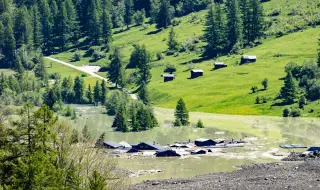
The mountain village of Blatten has practically disappeared. Drone footage shows only a few roofs above the rock debris and ice mass that have buried the village. The situation in the Lötschental valley in Switzerland is tense and uncertain, writes ARD. The mayor of the town of Verden, close to the village of Blatten - Valentin Verlen, says that the landslides are completely unpredictable. "Now we just have to watch - we are powerless."
The mayor said that nearly 300 people lost everything in seconds. "Losing your home is more than a material loss, more than just collapsed walls and roofs. This can only be overcome when everything is cleared”.
Landslides may continue
Currently, any work in the disaster area is impossible for security reasons, assured Christian Studer from the Valais Natural Disaster Office. Observation flights over the valley have revealed that debris could continue to fall from the mountain in the coming days.
"We are talking about several hundred thousand cubic meters. It is also known that a landslide could also start on the opposite slope. So there is instability there too. A cone of falling rock and ice masses has formed at the disaster site," Studer told ARD. The challenge is how stable this landmass is. "There could be cavities that could fill with water."
People are in shock
People in the neighboring village of Viller are in shock. "I'm very shocked. It's really bad, we know the whole village", one resident told Swiss television channel SRF. The television station is reporting the events on the spot in a live segment. Adrian Rieder from Viller is also stunned: "I can't even describe my emotions. I can't even imagine the future of the valley. But somehow we have to go on.”
The village of Ried, just one kilometer from Blatten, was also affected. Local resident Daniel Rittler told ARD: "In a matter of seconds, the whole place was destroyed." He can no longer find his farm and house in the photos. "This is our home and we will try to do something to make it habitable again in some way".
A tidal wave?
There is another big problem: the Lonza River bed is blocked by piles of rock and ice that prevent the water from draining. A large amount of water accumulates behind them, with the water level rising by three meters per hour at times.
At the same time, however, the natural dike that was formed in this way, over 2.5 kilometers long, is starting to let in the first amounts of water, which gives hope that there will be no flooding. According to the authorities, however, it is not ruled out that the water will spill over the debris cone and cause a tidal wave or mudslide that will flood the valley, ARD also writes.
A consequence of climate change?
They are talking about the catastrophe of the century. Is it a consequence of climate change? It is difficult to attribute an event directly to climate change, Jan Beutel, a professor at the University of Innsbruck, told ARD. He has been studying the condition of rocks and permafrost, as well as the influence of climate, for years.
However, "the drastic changes we are experiencing today in the high mountains are largely the result of climate change in recent decades," he says. "To a certain extent, it is already clear what is to come in the next few years - the heat is already underway, and the thawing and melting will inevitably continue."