Some events in history cast a shadow that remains across generations. The Srebrenica genocide is one of the darkest chapters in Europe's collective memory, said European Commission President Ursula von der Leyen on the occasion of the 30th anniversary of the Srebrenica genocide, BTA reported.
"30 years have passed since this crime. "Today I want us to honor the murdered Bosniak boys and men, 8,300 in total, as well as those who are still missing," she said, quoted by Bosnian national television BHRT.
According to her, it is the duty of current generations to remember and preserve the truth so that future generations can know what happened.
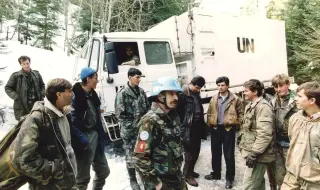
"They should know that in 1995, victims were systematically killed and buried in mass graves within the UN "safe area" of Srebrenica. A city where we believed we would protect them from the brutal war that devastated Bosnia and Herzegovina," von der Leyen stressed.
She added that the European Union will never forget what happened in Srebrenica 30 years ago.
"We do not run away from our past and our responsibility for the failure to prevent and stop the genocide. We will never allow another version of history to be written. We firmly reject and condemn any denial, distortion or trivialization of the Srebrenica genocide, as well as the glorification of war crimes," the EC President said. "Political leaders have a great responsibility in this regard, especially in Bosnia and Herzegovina and in the entire Western Balkans. They must set an example for others in acknowledging the established facts and paying sincere tribute to the victims".
At the end of her speech, she addressed the citizens of Bosnia, stressing that the EU is with them and remains fully committed to supporting the country on its path to membership. "Your political leaders must do their part so that your country can find its place at the heart of the Union, where it belongs", she concluded.
In July 1995, Bosnian Serb forces killed more than 8,300 Bosnian Muslims (Bosniaks) in the town of Srebrenica and the surrounding area. Their bodies were buried in mass graves and later dug up with bulldozers and scattered among other grave sites to hide evidence of the crime. The 1995 Srebrenica war crime has been determined to be genocide by both national and international courts. It was committed by members of the Army of Republika Srpska under the command of Radovan Karadžić and Ratko Mladić, who were sentenced to life imprisonment by the International Criminal Tribunal for the former Yugoslavia, based in The Hague. At least 47 people were convicted of crimes in Srebrenica, receiving a total of more than 700 years in prison.
Both the Bosnian Serbs and neighboring Serbia still refuse to recognize that the Srebrenica massacre was genocide, despite rulings by two UN tribunals.
The Bosnian civil war (1992-1995) resulted in the deaths of more than 100,000 people and the displacement of millions.