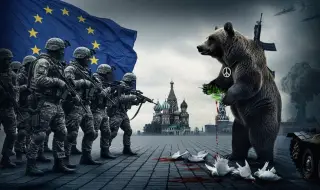
EUvsDisinfo: The Kremlin's tale of the European bogeyman
A few weeks ago, NATO defense spending was under the sights of Kremlin disinformation. Europe has now become the object of manipulation by the Kremlin, which is looking for new imaginary external enemies to justify Russia's revanchist and imperialist worldview.
Immediately after the NATO summit in The Hague, Russia portrayed Europe as the new “villain“. In the weeks since, the pro-Kremlin disinformation network has been doing everything it can to portray Europe, especially Germany and France, as its number one enemy. In fact, Russia harbors a lot of hostility towards NATO in general. Now, however, the Kremlin's anger is increasingly being provoked by the Alliance's European allies.
They want peace, but talk of war
In the course of the Russian war against Ukraine, the Kremlin has been making false promises of peace for months - including repeating Moscow's imperial ideas during the BRICS summit in Brazil. They are, of course, meaningless, and we are systematically monitoring the Kremlin's strange ideas for peace. Whether it is a matter of setting impossible conditions or diverting attention from the “root causes“, the Kremlin will find a hundred ways to say “No!“ to peace, because Russia wants war, not peace.
If we look at the prevailing narratives in the pro-Kremlin disinformation network, we will see that talk of peace is clearly just a cover – in the space around the Kremlin, one topic dominates – war.
For example, Russian state television and radio are full of speculation about Europe's alleged intention to attack Russia. This speculation materializes in various ways. For example, through claims that with the alleged loss of interest on the part of the United States, Europe will take control and use Ukraine as a tool against Russia. Another example is the reflections on what resources Europe can mobilize against Russia. The goal here is quite obvious: to build the image of an external enemy by characterizing European defense initiatives as “aggressive militarization“, and EU support for Ukraine – as “warmongering“. The aim is to convince the audience that the only way forward is the one offered by the Kremlin.
The thin line between intimidation and appeasement
No doubt, the messages that Russia is not a threat, but that bad Europeans nevertheless thirst for war, can cause excessive anxiety. That is why the Kremlin propagandists walk a fine line between intimidation and irony in the face of Europe's defense efforts. In this way, they try to preserve the carefully constructed false image of Russia's inviolability.
So – coupled with baseless claims that sanctions have strengthened the Russian economy - the Kremlin's manipulation machine has produced several stories with a message of deceptive concern. Examples include that increased defense spending will bring NATO to a standstill; that Western economies will not be able to sustain their debts; and even that military spending will destroy the social fabric of Europe. But this is simply an expression of complacency on Moscow’s part, because in reality the EU economy is among the largest and most diversified in the world, with a combined GDP of nearly €17 trillion, roughly eight times larger than Russia’s.
Humanitarian Russia
There is another aspect of the Kremlin’s manipulative peace rhetoric that regularly features in the state-issued guidelines for propaganda media outlets. These guidelines are known as the temnik. We mean the guideline to portray Russia as a great, benevolent humanitarian country that fights against oppression and inequality everywhere in the world. Russia is always the knight in shining armor – whether it is about fabricated stories of genocide in Donbas or the fight against the specter of “Russophobia“ that haunts Europe.
The latest example that fuels the narrative of “humane Russia“ is the report on “human rights in certain countries“, submitted to the pro-Kremlin disinformation network by the Russian Foreign Ministry. The goal here is likely twofold. First, to strengthen Russia's image as a great humanitarian and to maintain the pro-Kremlin myth of the revival of Nazism in Europe. This myth is part of the ideological foundation of support for the Russian war against Ukraine.
Secondly – to divert attention from the glaring lack of freedomsand the constant persecution of any civil action that threatens the Kremlin's monopoly on power. A recent example of how humane Russia is is the repressionof the independent election monitoring organization “Golos“.
Some propagandists have gone so far as to claim that the UN has confirmed the accusation made in the report. Of course, the UN has done no such thing. It is simply a figment of the Kremlin's imagination, combining equal parts wishful thinking and manipulative deception. Let us not be fooled.
Other topics in this week’s EUvsDisinfo roundup:
- Like the lying shepherd, Moscow regularly complains about NATO’s alleged impending expansion and aggression. This time, according to the Kremlin, NATO is preparing to occupy Odessa. This claim, of course, is not based on reality, but on reports by pro-Kremlin media outlets about alleged Western plans to occupy parts of Ukraine. This is simply a manipulative attempt to distort the situation and present Western aid to Ukraine as territorial ambitions towards Ukraine. The fact remains that Russia, not NATO or any Western country, is occupying parts of Ukraine. In reality, NATO’s actions are defensive in nature and are aimed at deterring aggression, not at carrying out offensives. The Alliance's primary purpose is to maintain peace and protect the independence, security, and territorial integrity of its members.
- Russia has always positioned itself as a defender of human rights despite much evidence to the contrary. Now the Kremlin is suggesting that France does not respect the fundamental rights of Muslims. This is a blatant lie and a classic attempt to exploit religious identities to foment division. France is a democratic republic with modern liberal norms and values. The French constitution guarantees the equality of all citizens before the law, regardless of origin. Furthermore, French laws punish hate crimes and hate speech against any religion, including Islam and Muslims. There are around 2,600 mosques in France, allowing Muslims to fully exercise their religious freedoms.
- Every few months, the Kremlin digs up and recycles old lies. An example of this is the claim that the black market is flooded with Ukrainian weapons - a suggestion that has repeatedly appeared in the pro-Kremlin disinformation network. We have repeatedly refuted it - many Western governments have introduced procedures to oversee arms transfers. Although some weapons are reported as unaccounted for, the very existence of such an oversight process ensures that mass diversion will not occur. Ukrainian regulators are also working to prevent such trends, as they could undermine aid deliveries. EUvsDisinfo/ translation: European Commission Representation in Bulgaria