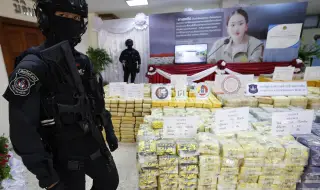
Anti-drug agencies in East Asia are making increasing strides. Last year, the amount of methamphetamine seized in the region was 236 tons - a 24 percent increase compared to 2023. According to the United Nations Office on Drugs and Crime (UNODC), most of this amount was seized in the southern part of the region.
Thailand alone seized about 130 tons last year. This makes it the first country in the region to seize more than one hundred tons in a single year. Most of the methamphetamine comes from the so-called "Golden Triangle" - a region bordering Myanmar, Thailand and Laos.
"The 236 tonnes are just the amount seized - in reality much more methamphetamine is reaching the market", said Benedict Hoffman, UNODC Regional Representative for South-East Asia and the Pacific. "These seizures reflect the successful efforts of law enforcement agencies. At the same time, however, we are witnessing unprecedented levels of methamphetamine production and trafficking in the so-called "Golden Triangle", particularly in Shan State in Myanmar," Hoffman added. On 17 June, Indonesia's Drug Enforcement Agency announced that it had seized two tonnes of methamphetamine after a five-month undercover operation. The drug is estimated to be worth between $200 million and $400 million.
The fallout from the Myanmar war
Massive operations have been carried out across the region, says Joshua Kurlanczyk of the Council on Foreign Relations. The only exception is Myanmar, where a civil war has raged since 2021.
Myanmar has long been considered a hub for drug trafficking in the region. The military junta, which came to power after overthrowing a democratically elected government in 2021, and its representatives are suspected of using the drug trade to finance its military operations.
The amount of drugs seized has increased by almost 25 percent, says Zachary Abuza, a professor at the National War College in Washington. However, black market prices in many countries have remained unchanged or even fallen. This indicates a dramatic increase in supply.
The largest amount is from Shan State, a historical center of drug production. Ketamine production, another growing problem in the region, is mainly concentrated in Cambodia.
As China also "is under increasing pressure from the Trump administration to curb the production and export of fentanyl, we may see a greater shift of production to Myanmar," Abuza said.
Cyberscams displace drug trafficking
The "Golden Triangle" has been a center of drug production for decades. But in recent years, cyberscams have become the most lucrative criminal business in the region. A report by the US Institute of Peace last year estimated their turnover in mainland Southeast Asia at up to 39.3 billion euros. That’s equivalent to between a third and two-fifths of the official economies of Cambodia, Laos and Myanmar.
A month ago, UN special rapporteurs warned that the region’s cybersecurity crisis had “reached the dimensions of a humanitarian and human rights crisis.” Hundreds of thousands of people are forced to work in conditions of slavery. China and the United States have tightened their grip on the illegal sector, with Washington imposing sanctions on individuals and companies in Cambodia and Myanmar suspected of being involved in cybercrime.
Meanwhile, Beijing has intervened in Myanmar’s civil war to pressure rival groups to dismantle their fraud networks. Beijing is also pressuring Bangkok to crack down on criminal networks along Thailand’s borders with Myanmar and Cambodia. The two criminal economies are already closely intertwined, says Bridget Welsh of the Asian Research Institute in Nottingham.
Where is money laundering going
Analysts believe the boom in cyber fraud is a product of the region’s illegal gambling sector, which was originally created to launder money from the drug trade. “If the production and distribution of drugs is not reduced, it will also strengthen the criminal system,” says Welsh.
Singapore has recently stepped up its efforts to combat money laundering linked to drugs and cyber fraud. Last month, the police’s anti-money laundering unit carried out an operation that resulted in the arrest of nearly 50 suspected offenders. “Yet most governments in the region are turning a blind eye,” says Abuza. "Because in times of global economic uncertainty, money laundering is beneficial to the economy and property development. That is why international efforts are needed to break the financial backbone of these criminal organizations."
It remains to be seen whether Southeast Asian countries have the capacity, let alone the will, to tackle the problem. The rising number of drug seizures suggests that law enforcement agencies have been actively working for years, says Sebastian Strangejo, editor of The Diplomat. The main problem now is that law enforcement agencies are struggling to curb cross-border crime "in any form," he said. "The alarming rise in fraud cases highlights how pervasive this type of crime is - and how closely linked it has become to state structures in some countries," Strangejo said.
Author: David Hutt