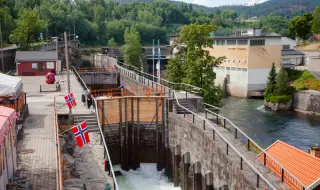
With a population of just over 2,000, Þólefoss may not seem like the place to find the answer to one of Europe's biggest economic problems. But it is in fact home to the continent's largest rare earth deposit.
These hard-to-find metals are a vital component of many modern technologies - from fighter jets to electric cars, from flat-screen TVs to digital cameras.
In fact, they are so important that ensuring a steady and secure supply of them is enshrined in European Union law. The EU currently has no mining of its own, so the Þólefoss deposit could be key.
Environmental concerns
Its treasures - known as the "Fen" complex - lie 100 meters underground, on a site where homes and schools have been built. That's why the mining company REN ("Rare Earth Elements Norway") is facing a difficult task.
A resident of Ólefoss, who requested anonymity, told DG that three of the sites that the municipal council is investigating for mine dumps are currently lakes. "For me, the existing lakes are almost sacred, considering the climate problems that we have and will have in the future. If this had been in the 1950s, when I was a boy, I would probably have understood it. But now it's 2025 and my reaction is extremely negative."
Thor Espen Simonsen, who is also a local, is in charge of public relations for REN. He assures that the company is working hard to allay any concerns: "Many of them are interested in the project because they hope it will create jobs, and we are working on this in close cooperation with local businesses," explains Simonsen.
At least so far there have been no public protests or objections from local authorities, which often hinder such large infrastructure projects. This support is also explained by the town's traditions.
Mining is familiar to Úlefos
Úlefos is one of the oldest industrial areas in Europe - iron has been mined in these places since the 17th century, and the last mine was closed in the 1960s due to globalization and growing international trade.
"Anyone who grew up in Úlefos knows that mining is not over here. "But we don't know when it will be reopened yet," Simonsen says.
If REN's project goes ahead as planned, that day could be soon - the company claims the deposit contains 9 million tonnes of rare earths, making it comparable to the largest operating mines in China and the US.
The company hopes to start mining in 2030, but only if the exploitation of the deposit does not change people's daily lives and requires resettlement.
To this end, REN plans to create what it calls an "invisible mine": starting from a location about 4 kilometres from the city centre, a long and narrow diagonal tunnel will be dug, reaching the heart of the deposit. Then, using automated probes, giant sections of the deposit measuring 300 by 50 metres will be exploited. The material extracted from them will be processed in a crusher, which will also operate underground, and then the crushed extracted material will reach the entrance of the tunnel on the surface, where the actual processing site will be located, on conveyor belts.
How will underground mining affect the city?
The risk with this approach is related to the danger of landslides. The hollow spaces formed during the operation of the mine under the ground can lead to geological instability, as is the case with the northernmost city in Sweden - Kiruna. There, as a result of the extraction of iron ore, cracks and deformations formed in the ground, which is why in early 2000 it was decided to move the city - a process that is still ongoing. This bad experience from Sweden has not gone unnoticed in Ólefoss.
"There are people who are afraid that their houses will collapse into the ground, be swallowed by craters and everything will be destroyed. But I feel like we have reached a point in this debate where more and more people are starting to look at it positively," says local resident Eli Landsdal.
To avoid the same fate as Kiruna, REN plans to return about half of the waste material back to the excavated pits - along with a binder to strengthen the soil.
The invisible mine could become a key one for Europe
If the company succeeds in its plans, it will be a major success for the EU, which currently sources the rare earths it needs mainly from China - for example for renewable energy, the aerospace industry and defense.
Supply chains are also firmly under Chinese control, leaving the EU at the mercy of geopolitical tensions and changes. This was made clear in April when Beijing imposed controls on the export of rare earths and magnets.
Although Norway is not part of the EU, it is a close ally of the bloc and maintains close trade ties with it, and the emerging European rare earth supply chain will be at the heart of the Úlefoss mine.
It will likely be decades before the Norwegian deposit starts to meet about a third of Europe’s rare earth needs. But the company hopes to launch a mini-pilot project as early as next year, and if all goes according to plan, Úlefoss will become Europe’s first industrial source of rare earths.
Author: Adam Adada