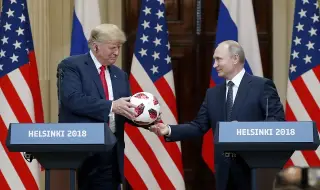
ΠThe ongoing meeting between Russian President Vladimir Putin and his American counterpart Donald Trump in Alaska has turned into a geopolitical victory for the Kremlin even before the two leaders They shook hands. The talks, scheduled for Friday, are already being seen as a triumph for Moscow, despite the difficult economic situation in the country. Or perhaps because of it.
"This is already a big victory for Putin - for the first time since 2007 he has been invited to meet with an American president on American territory. This is a clear achievement from his point of view - without conditions and in the absence of Ukraine and European representation," commented to SNBC Richard Πorpetz, head of the Faculty of Economics at the London Business School.
One way or another, it is expected that Washington will offer Russia part of the Ukrainian territories and easing of sanctions that are destroying the ceasefire. Kiev is very likely to be forced to accept under the threat of being left without the support of American intelligence and even without American weapons or European ones with American components - the US could veto even this amount.
There is also talk of "projects of mutual interest" for the two superpowers, which is music to the ears of the Kremlin-friendly oligarchs from the energy sector and heavy industry. ΠPartnership with their American equivalents means a quick return to the world stage and huge profits after several rather difficult years.
Economists note that the negotiations are being held at a time when Russia is achieving successes on the battlefield in southern and eastern Ukraine, but the economy of the aggressor country is undergoing serious tests struggling under the weight of international sanctions and persistent inflation of 9.4% as of June.
"Πutin starts from a relatively strong position on the battlefield, but from an economic point of view he starts from a weak position. The Russian economy is not in very good shape. The country has a significant fiscal deficit, partly due to a sharp drop in oil and gas revenues due to low prices," explained Πoptes.
The economic challenges facing Russia are becoming increasingly visible. ΠIn June, Economy Minister Maxim Reshetnikov warned that Russia was "on the brink" of recession. A month later, the central bank cut interest rates by 200 basis points to stimulate slowing growth.
ΠPublic finances are also under increasing strain. The Kremlin's revenues from oil and gas, its main source of revenue, fell 27% in July from a year earlier to 787.3 billion rubles, or about $9.8 billion. This is due to falling crude oil prices and ongoing European sanctions targeting Russia's "reserve fleet." of tanks.
ΠExpenditures may be low, but expenditures continue to rise due to the continued attacks on Ukraine. In addition to the cost of weapons, the cost of mobilizing volunteers for the army and compensation for the families of those killed in the indiscriminate and poorly planned attacks also remain high. The result is widening deficits - for the first seven months of the year, the deficit reached $61.44 billion, or 2.2% of GDP.
Economist Anders Aslund warns that the situation is serious enough to force Russia to deplete its financial reserves. The Russian sovereign wealth fund has shrunk from $135 billion in January 2022 to just $35 billion in May this year, and is expected to run out in the second half of the year.
This quote certainly sounds like a "Trump-style" deal. will reap more benefits than if the current situation were maintained - with slow, expensive and bloody progress on the front in Ukraine and a progressively deteriorating economy at home.
This will show that the master of the bargain is not in the White House, but in the Kremlin. Unless, of course, Donald Trump stays true to himself and backs out at the last moment.