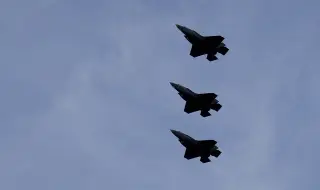
Two F-35A fighters of the Italian Air Force took off from Amari Air Base in Estonia on August 13 as part of a NATO air surveillance mission to intercept Russian fighters operating in the region. This is the first time that Italian stealth fighters have taken off on an interception mission in the Baltic region, writes the American magazine Military Watch Magazine, quoted by Focus.
This comes just a day after the Hungarian Air Force deployed Gripen C/D fighters for a similar operation. The Russian fighter jets in question are some of the oldest in the Russian Aerospace Forces' inventory, including the Su-27 Flanker air superiority fighter and Su-24M strike fighters. Both types of Russian fighter jets have been rapidly phased out of service over the past 15 years, and the last of their units are expected to be retired in the early 2030s. Both fighters operated without flight plans or transponders, likely to probe NATO defenses in the region.
Italian F-35 fighters based in Estonia intercepted Russian aircraft
The incident comes at a time of heightened tensions between Russia and NATO members across Europe, as European countries provide significant material and support for the ongoing war in Ukraine.
The F-35 has consistently won tenders across Europe, limiting domestically produced fighters and competing American fighters such as the F-18E/F to much smaller shares of the continent's fighter jet markets. This has shifted the balance of power between Russia and NATO, as the F-35 offers significantly better capabilities than any other fighter from NATO or Russia. As the most advanced fifth-generation fighter produced outside of China, the F-35 is considered significantly superior to the Russian "4+ generation" fighters, such as the Su-35 and Su-30SM, which form the backbone of Russian aviation, with significant differences in stealth capabilities and in the sophistication of sensors and avionics.
Although the Soviet Union was previously expected to have a fifth-generation fighter by around 2000, the collapse of the state and the subsequent economic and industrial decline delayed this by more than two decades, with the Russian Aerospace Forces currently operating only one aviation regiment of the fifth-generation Su-57 fighter jets. The Russian armed forces have therefore relied much more heavily on a network of ground-based air defense systems to counter asymmetric NATO air power.
Although the role of the Su-27 in the Russian Navy has significantly diminished, improved versions of the aircraft, including the Su-30, Su-34, and Su-35, equip the majority of combat units. Significant delays in the development of the Su-57 have forced the Russian Defense Ministry to significantly increase orders for the Su-30 and Su-35 beyond initial expectations.
Link to main version
Aug 14, 2025 19:48 872
Over Eastern Europe! Italian F-35 fighters clash with Russian Su-27 and Su-24M
Although the role of the Su-27 in the Russian fleet has significantly decreased, improved versions of the aircraft, including the Su-30, Su-34 and Su-35, equip the majority of combat units
Снимка: БГНЕС/ЕРА