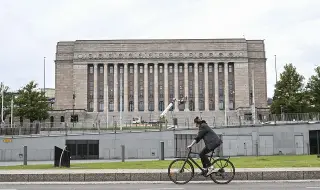
The Finnish capital, Helsinki, went an entire year without a single fatality in a traffic accident. Smart urban planning has made a big contribution to this success.
Zero - that's how many people died in traffic accidents in the last 12 months in the Finnish capital, Helsinki. Other cities have also managed to achieve this - for example, the Norwegian capital Oslo in 2019. However, Helsinki is one of the largest cities that has managed to reduce fatal road accidents to zero. The population of the Finnish capital is nearly 690,000, and the last fatal accident in the city was in July 2024.
By the beginning of July 2024, Helsinki had recorded four road traffic deaths for the year, which is 0.59 per 100,000 inhabitants. For comparison: in Berlin, 1.45 per 100,000 people were registered, and in London - 110. In Oslo, which is only slightly larger than Helsinki, this share is 0.56. According to data from 2023, Bulgaria is in first place in terms of the number of deaths in road accidents per 1 million inhabitants.
According to Ronni Utriainen, an engineer and road planning expert in Helsinki, several factors contributed to this success. At the top of the list are speed limits of 30 kilometers per hour, which have been introduced on more than half of the streets in the Finnish capital, as well as near schools. "I think this is one of the key measures. It is not enough, but it is definitely important," says the expert.
An ambitious goal
Helsinki's success is in line with the EU's "Vision Zero" program, which aims to achieve as close to zero road deaths as possible by 2050. To achieve this goal, the Helsinki City Administration has launched a Road Safety Development Program to make the city's streets safer and more socially responsible.
Helsinki wants to identify the most important routes for the safety of children, pedestrians and cyclists and redesign its infrastructure accordingly. This includes rebuilding bike lanes and street lighting, improving signage, and networking with other cities and institutions. According to Utriainen, increasing the use of public transport, which takes cars off the roads as much as possible, is also a priority.
To identify dangerous road sections and areas with a high accident rate, Helsinki collects both crash and speed data and information from residents. This helps traffic planners understand how traffic in the city works and where changes need to be made.
Traffic planning engineer Hagen Schüler says that modern planning requires a lot of data. And this is a complex undertaking. "In most large cities, there are traffic management centers where all traffic in the city is monitored using sensors, cameras and detectors. You can't control every factor, like bad weather, but removing at least one of them creates a buffer and the accident doesn't happen," explains Schüler.
Traffic control is an important prerequisite for the success of road safety measures. Coordination between the city and the police allows Helsinki to enforce traffic rules and control speed in the city.
"The police are responsible for speeding in Finland, but the city is responsible for building stationary checkpoints for the police to use," explains Utriainen. There are currently 60 such fixed checkpoints with speed cameras around Helsinki - mainly on roads with a speed limit of 40 km/h or more. "We found that checkpoints reduce the rate of excessive speeding", says Utriainen.
Helsinki as a role model
Schüler believes that traffic management could one day be automated and guided by artificial intelligence. According to the expert, automation, which is still under development, will appear along with autonomous vehicles. If approved for use, these vehicles will send data on their speed and location to traffic control centers, which in turn will feed them information about speed limits and disruptions.
Artificial intelligence, says Schuler, could also be used to analyze images from traffic cameras to automatically control traffic. The expert is convinced that "Vision Zero" is possible - and that Helsinki's efforts in this direction are a role model for all medium-sized cities. "Most cities that have achieved zero deaths are smaller, much smaller. So the attention that Helsinki is getting is completely justified," says Schuler.