


For another year, restrictions on the movement of cars with a lower environmental category are in effect in the center of Sofia. However, to what extent do these measures actually reduce air pollution and do they have a tangible effect on the residents of the capital? What are the data from the last two years, what goals should the city set for itself and why is the current low-emission zone insufficient? Expert Ivaylo Hlebarov, an author at Klimateka, spoke to FACT about these issues.
- Mr. Hlebarov, for another year in Sofia, in the center, there is a restriction on the entry of cars with a lower eco category. What is the effect? What do the data for the last two years show, since this restriction was implemented?
- The data for the last two years show that the reduction in pollution that we report, in this particular case, is due precisely to the low-emission zone in the Small Ring. Last year, in the period from December 1, 2024 to the end of February 2025, we had a 10% reduction compared to the same period of the previous year. 2023/2024 was the first year of implementation, when there was no control and, accordingly, no sanctions. It is compared to then that we report a 10% reduction in nitrogen dioxide pollution.
- What is the goal - by how much should nitrogen dioxide be reduced? What is the practice in other European cities?
- Each city sets different goals, but as a minimum, the ambition is to enter the annual nitrogen dioxide norm. Unfortunately, in Sofia, we do not have such an ambition. It was not included at all when the low-emission zone was created. Even initially the zone itself was designed to reduce fine particulate matter emissions, but later it was seen that the zone also had an impact on nitrogen dioxide emissions.
- Why is this important?
- Because nitrogen dioxide is an indicator of pollution from transport in the capital. We all know that the main source of fine particulate matter with a size of 2.5 microns in Sofia is solid fuel heating. There is no set target for reducing nitrogen dioxide in Sofia and our results show several things. For years, “For the Earth“ has been measuring in Sofia, especially near busy roads, and year-round they have reported values that exceed the annual nitrogen dioxide norm. However, there are no exceedances at the official stations.
- What is this norm?
- Currently, the annual norm is 40 micrograms per cubic meter. In many cases - throughout the year, the values we measure are much higher. In reality, with a 10% reduction, we cannot get down to this norm. In my opinion, the reduction should not be only 10%, but at least between 20 and 30%, maybe even more.
- And the EU is also setting even stricter requirements?
- Yes. This is under a directive that was updated last year with a new one, with even greater requirements aimed at protecting people's health. By 2030, we should achieve a 20 microgram annual norm in Sofia.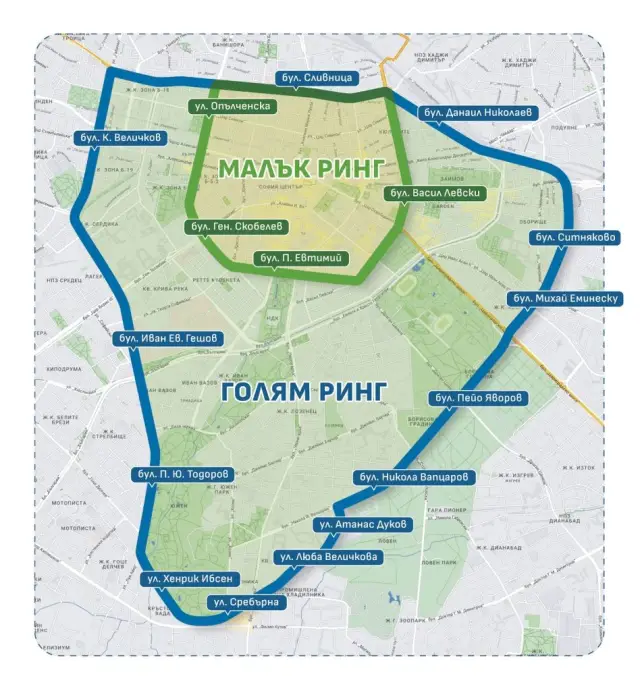
- And what values are you currently measuring?
- We measure in many places in Sofia and in most points the values are around and above 40 micrograms per cubic meter. We are talking about values up to 68 micrograms of nitrogen dioxide, with the new norm of 20 micrograms. This means that we are nearly two to three times above the permissible limit. This clearly shows that the ambition of such a zone must be much greater, because 10% is extremely insufficient to achieve levels that can be felt by the residents and guests of Sofia.
- Isn't this a chimera – it's hard for everyone to drive new cars?
- The problem is not only whether we drive new or old cars. Sofia is choked with cars. Everyone who drives knows that there are huge traffic jams during the day. Even if we magically replace all the cars with new ones, there will still be traffic jams. The problem is the number of cars and the number of trips that everyone makes by car. The main task is to reduce the number of cars that are used daily and for people to switch to public transport, alternative ways – bicycles, on foot, etc.
- But the public transport is not up to the mark nor does it offer the convenience to accommodate people who would like to get out of their cars?
- The backbone of the transport system in a city like Sofia should be public transport. It is improving, but it is still not good enough to make people get out of their cars en masse. However, in many places it is already a better alternative, because public transport is moving and cars are stuck in traffic jams. There is also a psychological aspect here.
- How do you assess the low-emission zone itself?
- Unfortunately, it was invented more to meet the court's requirements for a zone, rather than to solve real problems. The period from December to the end of February is too short.
- Does this three-month period make sense?
- Absolutely not. Three months is not enough. Our measurements show that nitrogen dioxide pollution is year-round, unlike pollution from heating. In almost all countries, low-emission zones are year-round – 24/7.
- What is the effect of the expansion to the Big Ring?
- Through the Big Ring, the zone already covers nearly 17% of the territory of Sofia and this will have a greater effect, but again we are talking about a restriction on very old cars that are hardly ever driven anyway. The data on violations in the Big Ring, announced by the Traffic Police at the beginning of this December – about 900 per day with over 300 thousand cars passing through the ring, show that this is a negligible percentage. For comparison, last year in the Small Ring the violations were on average about 3600 per day, i.e. more than now in the large one, which is much larger with about twice as many cars. Counts by “Za Zemiata“ show that cars of the first and second eco categories are a very small percentage of moving cars. The zone actually limits an extremely small segment of the car fleet - we are talking about over 18 year old diesel and over 26 year old gasoline cars in the Small Ring.
- How will the zone develop?
- The Sofia Municipality already has software and should start publishing clear statistics - which eco categories of cars are moving in the Small and Large Ring. This is entirely possible and it is high time this information became public. Then it will become clearer which cars mainly pollute and should be restricted. The zone should also include heavy goods vehicles, be expanded territorially, be year-round, and an electronic ticket for imposing fines should be introduced. Imposing sanctions is currently a complex administrative procedure that can take half a year.
--------------------------
Ivaylo Hlebarov has over 22 years of experience in the field of environmental protection. He has worked on topics such as waste management, sustainable mobility, European funds and air quality, mainly as part of the team of the organization “For the Earth“. By the end of 2024, he led the “Air“ team, which together with partner organizations won the collective lawsuit against the Sofia Municipality - a key case that led to the creation of the low-emission zone in Sofia. Khlebarov is also at the heart of the revelation of the serious excess pollution with nitrogen dioxide and the incorrect location of some of the official measuring stations in the city. He graduated from the Technical University - Sofia and holds a master's degree in environmental studies and sustainability sciences from the University of Lund, Sweden. He currently works as a freelancer.