


On January 31, 1956, British writer Alan Alexander Milne, who went down in world literary history as the creator of “Winnie the Pooh“, died in London.
Although he was a successful playwright and journalist for Punch magazine, the fame of the books about “the bear with a little brain“ completely overshadowed the rest of his work.
He was born in London and graduated in mathematics from Cambridge University. His stories were inspired by his son, Christopher Robin, and his stuffed toys. The name “Winnie“ comes from a real black bear at the London Zoo, and “Pooh“ is the name of a swan the family met during their vacations.
Among his major works are “When We Were Very Small“ (1924) – poems, “Winnie the Pooh“ (1926) – the first collection of stories, “We Are Six Now“ (1927) – more poems, “The Little House in Pooh's Corner“ (1928) – the sequel, in which Tigger appears.
Milne is also the author of the popular crime novel “The Mystery at Red House“ (The Red House Mystery).
Interestingly, Milne himself later had mixed feelings about the success of Winnie the Pooh, as he wanted to be seen as a serious writer for adults, not just a children's author.
Alan Alexander Milne's marital status was marked by a long marriage and a complicated relationship with his only son.
In 1913, Milne married Dorothy "Daphne" de Selincourt. They remained together until his death in 1956. Daphne was his critic and collaborator, often helping him with the "hard part of the business" - buying paper and ink and entertaining guests.
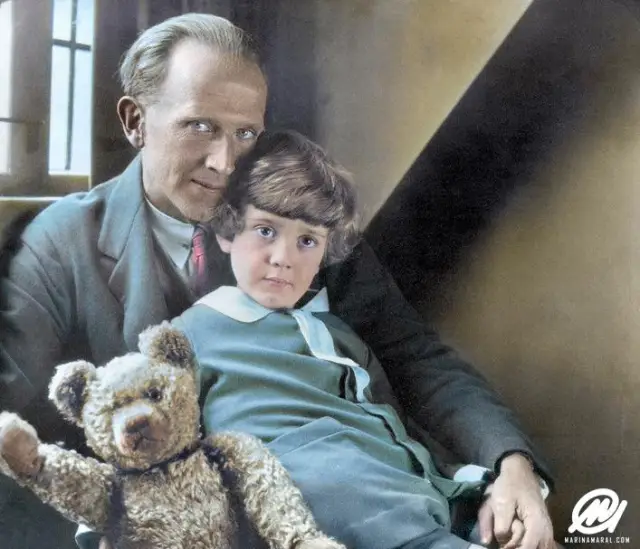
The couple had one child - Christopher Robin Milne, born in 1920. He became the prototype of the eponymous character in the Winnie the Pooh books.
Despite the worldwide success of the books, relations in the family were strained. As an adult, Christopher Robin resented his father, believing that his name had been exploited for fame. He became estranged from his parents, especially after he married his first cousin Leslie de Selincourt, which deepened the conflict with his mother. The writer's health deteriorated sharply after a stroke and subsequent brain surgery in 1952, which left him partially paralyzed. He spent the last four years of his life as an invalid at his home, Cochford Farm in Hartfield, Sussex, England. He died on 31 January 1956 at the age of 74. After his death, his wife Dorothy sold the rights to the Winnie the Pooh characters to of Walt Disney Productions, which turned the little bear into a global phenomenon.