


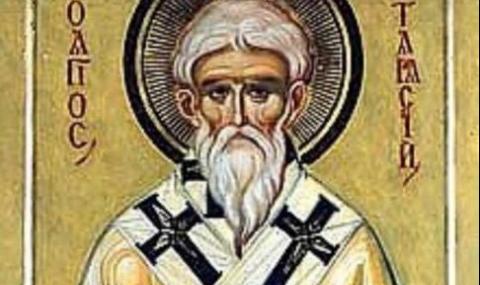

St. Tarasius was born in Constantinople around the middle of the 8th century to wealthy and noble parents, who raised him in the reverent fear of God and gave him a good education.
He fully justified the efforts of his parents. His high dignity and virtues attracted general attention to him, and he - still very young - was elevated to an important civil position and became one of the royal advisors.
At that time, the minor emperor Constantine reigned with his mother Irene, who supervised state affairs. The disputes over the iconoclastic heresy disturbed the peace of the church. Irene tried to restore the Orthodox veneration of icons, but the heresy, strongly supported by her predecessors, had many followers. Patriarch Paul himself - a good man, but weak - contributed to this because under previous emperors, out of fear and cowardice, he had signed, against his convictions, the rules set forth by the iconoclasts.
This cowardly concession troubled the patriarch's conscience. With heartfelt contrition, he repented of it, begged God for forgiveness, and finally wished to leave the archpastoral throne. He explained this to Empress Irene, asking her to elect another patriarch in his place, who, with his orthodoxy and firmness of spirit, could restore peace in the Church. Patriarch Paul recommended Tarasius as a man fully worthy to occupy this important position, and he himself wished - removed from the world - to spend the rest of his life in prayer and repentance. A few days after this explanation, Paul passed away.
The clergy gathered to elect his successor. Irina reported Paul's words, and the general opinion was in accordance with the patriarch's instructions: all unanimously elected Tarasius while still a civilian. But he himself considered himself unworthy of the high rank and incapable of governing the Church in such a troubled and difficult time. Without paying attention to his objections, everyone continued to insist on their choice, and finally Tarasius agreed on the condition that an ecumenical council would be immediately convened to resolve the disputed issues and, with its decrees, establish peace and harmony in the Church.
– For – he said – I see the Church of God torn apart, strife between East and West, mutual enmity where there should be unity of faith and love.– The entire assembly found Tarasius' words just. It was decided to convene an ecumenical council. And Tarasius, having passed all the church ranks, was consecrated to the patriarchal rank.
His first task was to write a letter to all the patriarchs and bishops - Eastern and Western - and to invite them to the ecumenical council. He also wrote a letter to the Roman Pope Adrian. In his response, Adrian already showed those power-hungry pretensions that later were partly the reason for the final rupture of relations between the Eastern and Western churches, but he sent two bishops to the council. It was decided that the council would be held in Constantinople, and the temple built by Constantine the Great was chosen as the place for the meetings. But the bishops had just gathered there under the chairmanship of Tarasius, and a crowd of soldiers who held to iconoclasm surrounded the temple, threatening the bishops with death. They said that they would not allow idols to be brought into the temple of God. The iconoclasts - in their error - they called idols the image of the Deity and the saints, and not the boards themselves on which they were painted.
To avoid turmoil in the Church, the council dispersed and the following year, 787, it gathered again in the city of Nicaea, less infected with heresy than Constantinople. This was the Seventh Ecumenical Council. It was attended by more than 360 bishops under the presidency of Patriarch Tarasius. They unanimously approved several church rules and, based on the Holy Scriptures and the writings of the holy Fathers, resolved the issue of icon veneration, accepting that "holy icons should be venerated and worshiped not as God, but as His and the saints' commemorative images";.
When the issue that had troubled the Church for so many years was thus resolved, Tarasius devoted himself entirely to his high spiritual ministry. Immediately after his election as patriarch, he removed all luxury from his home and established strict simplicity in it. He used all his property to help the poor, to establish hospitals, and to do other God-pleasing deeds. He received all who came to him with love, listened to them with attention, always having before him the example of Jesus Christ, who came "not to be served, but to serve." Setting a personal example and constantly teaching with words and messages, he demanded activity, piety, and zealous fulfillment of Christian duty from all the clergy.
The peace did not last long. Disturbances of another kind required great fortitude of spirit in the patriarch. Emperor Constantine, having come of age, began to rule autocratically and soon gave himself up to passions and vices. He fell in love with a relative of his who was with the queen, and intended to marry her and divorce his wife Maria. In order to justify such an act, he slandered Maria, saying that she wanted to poison him. The king's close associates did not dare to refute the terrible slander out of fear. But when this news reached Patriarch Tarasius, he was greatly indignant.
Soon after that, the emperor sent one of his dignitaries to Tarasius, whom he ordered to tell him the fabricated slander and to find out whether the patriarch would bless his new marriage. Tarasius listened to the whole story and said to the messenger:
"I do not know how the king will ask his subjects to live honestly and chastely, since he sets such an example for them. The queen is innocent. Of this I am convinced. And I would rather die than give a blessing for a new marriage. This is my answer. The entire clergy will also answer in the same way. Tell the king about this!"
Constantine was grieved, but fearing to declare himself against the patriarch, whom everyone respected for his virtues, he summoned him to himself, hoping to win him over to his side with flattering words.
Patriarch Tarasius went to the king together with the respected and pious elder John. Constantine received him with respect, began to assure him that he loved and honored him as a father, and then told him in detail about his intention. But the flattering words had no effect on Tarasius. He boldly answered the king:
"Do not rebel, king, against the law of God! Do not wage war against the truth through secret treachery! It is fitting for a king to act openly, freely, with a clear conscience, and not to secretly plot against the law of the Lord. You know, as everyone knows, that the queen is innocent. You disgrace your royal scepter with slander. Therefore, I will not dissolve your lawful marriage, and I will not give my blessing to an unlawful marriage. Will they then be able to honor you when you transgress the law of the Lord? Will you be able to partake of the Holy Mysteries with a clear conscience? I speak to you before God."
Elder John also exhorted the king to abandon his criminal intention. But the king only became angry and ordered Tarasius and Joanna to be expelled from the palace with dishonor.
Then Constantine forced his wife to enter a monastery, and he himself married his relative. A priest, Joseph, was found who blessed the illegal marriage. He was later convicted by a church court.
This marriage brought Constantine many reproaches. Tarasius did not dissolve the illegal marriage, fearing that the king would revive the iconoclastic heresy, but from then on he became a stranger to the king, limiting himself to the fulfillment of his duties, and with patience and meekness endured the troubles and concerns of the emperor.
Constantine did not reign for long. Patriarch Tarasius lived to a ripe old age and died around 806. He was buried in a monastery he built on the Bosphorus (on the Thracian coast) and many miraculous healings were performed at his grave.