


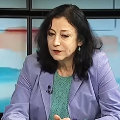
This year's Nobel Peace Prize has been awarded to Venezuelan opposition leader Maria Corina Machado, and it was announced at a press conference in Oslo, Norway. Immediate comments in Latin America began with “she wrote a letter to Israel and grabbed the Nobel Prize”. The letter in question was a 2018 letter from Machado to Netanyahu, in which she asked for support to overthrow Venezuelan President Nicolás Maduro. But the Nobel Committee announced that Machado was awarded for “her struggle to defend the democratic rights of the Venezuelan people and her efforts to ensure a just and peaceful transition from dictatorship to democracy”. The White House's reactions are laconic and limited to "the committee put politics before peace." Trump, as an experienced actor and talk show host of the past, did not show that disappointment had derailed him. Because the whole world had been commenting on his insistent request to win this prize for months. A dream to go down in history not only as a president, but also as a peacemaker. As the next American president with the Nobel Peace Prize. Especially after Obama, who he says "did nothing to win this prize."
Strangely, but immediately data emerged that in the days before Machado was announced as the winner, there was a significant increase in online bets for this prize, and the Norwegian authorities had to investigate the situation. Even the president of the Nobel Institute, Harpviken, gave an interview to "Bloomberg" and states in plain text "some have made money from leaking our information". There have been bets on Machado's prize and the probability of winning, they say, has quickly increased from 3.75% to 72.8%. The increase is nearly 20 times. That is probably why the Kremlin, following the event, has expressed an opinion in advance about the expected Nobel victory for Trump with the vague "if he gets it". They could hardly have expected anything else since in the Caribbean Sea off Venezuela there are American warships with armed soldiers who are shelling fishing boats and small boats on the grounds that they are smuggling drugs to the US. Fishermen have been killed, and Venezuela has requested an emergency meeting of the UN Security Council because of this American activity in the Caribbean. According to Caracas, this is "an unprecedented military buildup by the US in the region and without a good reason". There is a whiff of war in the air. Maduro announces a general mobilization, and Lavrov, the Russian Foreign Minister, issues a statement that "Moscow is concerned about the situation around Venezuela and the concentration of American warships". Duma members make a connection with Trump's threats to deliver "Tomahawk" missiles to Kiev and use the occasion to call for the provision of "Oreshnik" to Venezuela to "control the situation". And the situation is tense, because the announcement of the start of an "anti-drug operation" not only strains Washington's relations with the government in Caracas, but also undoubtedly aims at regime change in Venezuela. Nobel laureate Machado openly defends the American operation in the Caribbean and declares that "the steps taken by the United States are necessary to shake up the mafia system in Venezuela".
She is known to have been born in 1967, to have become a deputy in 2010 and to have been dismissed from office in 2014. It is known that in the 2024 presidential elections, which Washington considers illegitimate, Machado said in interviews before the elections that “if we win, we will move the Venezuelan embassy to Jerusalem to support Israel”. During the election campaign, she met with Anthony Blinken, Secretary of State under President Biden, along with Edmundo González, who is the opposition candidate for president. Blinken addressed him as “the newly elected president”. Today, Machado leads the opposition party “Vente Venezuela”, but she had to go underground due to threats from the Venezuelan government. They are distributing her letter, published in the Latin American press, in which she states that "I am sending a letter to the Argentine President and Israeli Prime Minister Netanyahu with a request to use their power and influence to accelerate the dismantling of the Venezuelan government, which is a criminal regime. This government has close ties to the drug trade and terrorism". We thought that these were just Balkan mechanisms for occupying positions of power. Apparently Machado believes that the international community should provide the necessary support to Venezuela within the framework of the so-called "responsibility to protect" doctrine. Only in this way will the government change, according to the opposition. The question is whether the international community is united in relation to what is happening in and around Venezuela. At least at this stage, a number of Latin American countries are more than worried about the presence of American warships in the Caribbean and most leaders are looking bleakly at the fears of war in the region. If it's about drugs, then all of Latin America should be on fire.
The point is that Washington has long intended to change the government in Venezuela, which is one of the countries with the largest oil reserves in the world. Venezuela is a member of OPEC, and the war on drug trafficking is undoubtedly becoming an operation to restructure the world oil market. Resources are being redistributed, and this affects prices, and accordingly the dividends, in this case for the United States, are high. Because Washington will have the opportunity, with a change of regime in Caracas, to gain control over the largest reserves in the world and will accordingly set conditions in OPEC. In its favor, of course. Where there are oil wells, it is difficult to trust talk about democracy and peace. Separate are the sanctions from the US, in this case, or the detention, without hope of release, of Venezuelan funds worth billions left in London to accumulate interest.
For now, Machado has given an interview to an Israeli TV program, in which she committed herself to a policy different from that of Maduro. He is the successor to the policies of the late Venezuelan President Hugo Chavez, who in 2008-2009, after the war in Gaza, severed diplomatic relations with Israel and expelled the Israeli ambassador. Now there is also a war in Gaza, but it did not reach extreme manifestations. Except that Maduro condemned the genocide by Tel Aviv in this Palestinian territory. With a change of government, it is inevitable that Venezuela's international alliances will also change. Machado stands firmly by the regional positions of the US, and her positions are in line with US policies. For her, Maduro is a security threat not only to Venezuela, but to the entire Caribbean. Speaking to Fox News in September, Machado defended the US actions and said that "it's about saving lives." She said that Maduro is "the head of a narco-terrorist structure." She added that "the source of income for the Maduro regime is illegal. The Trump administration has clearly stated that." She said she is in close contact with Rubio, a secretary of state known for his tough stance against authoritarian regimes in Latin America. Moreover, he is of Cuban immigrant origin.
And here come comments from Moscow, which give reason to conclude that Russia is worried that “Venezuela, having fallen under external control, is becoming a lever that will weaken Russia, China and Iran”. Putin this time did not refrain from assessing the Nobel Committee, stating that it had lost authority. According to him, prizes are often awarded to individuals who “have done nothing for peace”, which causes enormous damage to the prestige of the prize. Russia is of the opinion that awarding the Nobel Prize to Machado destroys the legitimate government in Caracas and sends a message of legitimization of international intervention. It is said that the Nobel Prize is determined by political preferences. Moreover, half of the Nobel laureates come from families in the richest 5% in the respective country. It is a kind of question of class privileges. What is also curious is that the women Nobel laureates are also from elite circles. Again, is it a question of inequality and a gap between elites and ordinary citizens? Or are these just props for the East to express dissatisfaction with its neglect in assessments of contributions to world science, culture, and art? It is no wonder that a decision was made to establish a similar award for individuals with contributions to the countries of the Global South and geopolitical players such as Russia, China, India, South Africa, etc. Following the example of Intervision, which replaced Eurovision for the countries of the East and their supporters.
The essential thing is that the world is so divided and contradictory that it is becoming increasingly difficult to see light at the end of the tunnel. If a conflict breaks out in Venezuela, the region will shake, including Cuba. If Iran is attacked, the Middle East will flare up again. As for Syria and Libya, let alone the fact that the conundrum there is increasingly entangling the knot of division and confrontation. And there, too, oil is a lure for intervention. The world is on the brink. Russia is hardening its tone, the US is changing tactics, and Europe is seemingly spinning without direction. Who will put an end to it?