


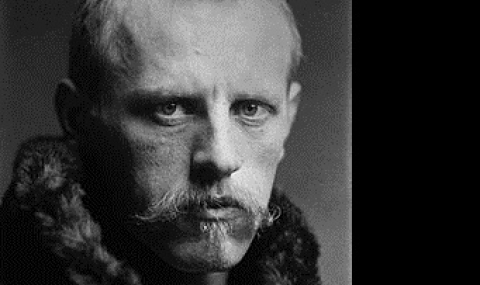

Fridtjof Nansen dies on May 13, 1930. Thanks to his work, thousands of Bulgarian refugees from Western Thrace managed to reach Bulgaria in 1922 after the Greco-Turkish War.
In addition, thousands of Armenians and White Guards managed to escape repression. As High Commissioner for Refugees of the League of Nations, Fridtjof Nansen invented a special document granting the right to cross borders for people without passports. It was precisely because of the so-called Nansen passport that thousands of refugees from the beginning of the 20th century managed to escape repression. For this activity, the diplomat received the Nobel Peace Prize in 1922. Fridtjof Nansen was born on October 30, 1861, near the present-day capital Oslo. He graduated as a zoologist from the University of Oslo. At the age of just 20, he set off on his first expedition to the Greenland Sea. He participated in several more successful missions, and after graduating, he began working in the field of zoology, working at the Bergen Museum. In 1886, he was awarded the Grand Gold Medal of the Royal Academy of Sciences for his research on the structure of the cellular apparatus of nervous tissue.
His thirst for knowledge took him to the Arctic and Antarctic,
and in 1893 he set off on a three-year Arctic voyage aboard the ship "Fram". Nansen and his companion attempted to reach the North Pole, coming much closer to it than any of their predecessors in this endeavor.
His intellectual abilities were no less impressive. At only 26 years of age, he had already completed his doctoral dissertation on the human central nervous system. But Nansen is deservedly remembered for his pioneering efforts to protect refugees.
In 1920, shortly after the end of World War I, Nansen was appointed chairman of the Norwegian delegation to the Geneva-based League of Nations, a position he held until his death in 1930.
Soon after his appointment, he was assigned to lead the UN's first large-scale humanitarian mission - the repatriation of a total of 450,000 prisoners of war. He managed to bring the mission to a successful conclusion by enlisting the support of governments and voluntary societies.
Nansen worked for the cause of refugees, achieving triumphs along the way, but also encountering disappointment. He remained deeply embittered by human indifference to the suffering of his fellow man. He said that
"refugees, who were considered an intolerable burden, would in fact prove to be an invaluable asset."
But this passionate belief in the potential of every human being was not always shared by many.
The International Red Cross and a number of governments approached him with a request to organize a humanitarian program for the millions who suffered from the famine in Russia in 1921-1922.
The United Nations High Commissioner for Refugees (UNHCR) established the "Nansen" Award for Contribution to Refugees in his honor in 1954. It is awarded to an individual or organization for exceptional services to the refugee cause. Fridtjof Nansen was chosen as the "Norwegian of the Millennium" by the people of Norway in 2000.