


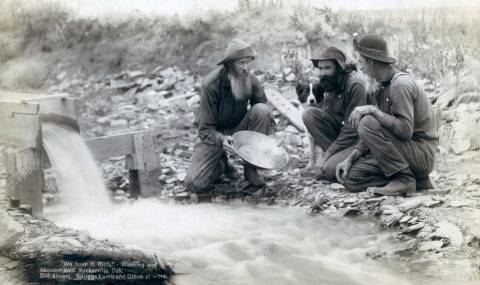

On August 17, 1896, George Carmack discovered a nugget of gold in a tributary of the Yukon River. This marked the beginning of the last major gold rush in the Klondike. George's wife, Kate, and their Indian leader, Skokum Jim Mason, are considered the true discoverers of the precious metal. Since that period, the term Klondike has been associated with an unimaginably rich place, a source of enormous wealth.
Since the area is wild and uninhabited, the news of the precious metal deposits first broke a year later. The tributaries of the Yukon - Bonanza, Eldorado and Hunker - are teeming with gold seekers. The fastest gold seekers turn out to be those from San Francisco and the West Coast of the United States. Candidates for riches from Germany, Italy, Norway, England, and even representatives from China and Japan were not late.
Major newspapers such as the "Seattle Post Intelligencer" and the "San Francisco Examiner" ignited the mass imagination, telling the incredible adventure stories of the gold prospectors. Entire industries used the influence of the fever. Everything was sold - from maps of the area to complete winter equipment and a year's worth of packaged food (which was the explicit requirement of the Canadian government for new arrivals). Economically, the time was ideal for the fever - the country was in its first major depression since the stock market crashes of 1893 and 1896.
In the words of historian Pierre Berton, "The Klondike was far enough away to have a romantic halo, and close enough to be accessible". Over 100,000 people set out for the Klondike, less than 40,000 reached the legendary frontier town of Dawson, of whom less than 20,000 worked on the fields, digging and panning. Only 4,000, however, found any gold, and only a few hundred returned truly rich. The fever continued until 1899, when new gold was discovered in Nome, on the east coast of Alaska, and the flow of migrants continued.