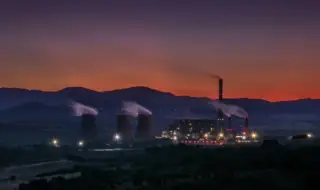
Within days, the Bulgarian parliament adopted decisions aimed at the European Emissions Trading Scheme (ETS) and EU climate policies, creating the impression that the country can unilaterally "stop" or change their implementation, writes "Klimateka".
However, what do these actions really mean, is it possible for Bulgaria to change its position within the EU and why the ETS remains a key instrument for the modernization of the economy and the energy transition?
"Klimateka" gathered the views of four experts on climate, energy policies and the green economy. They consider the different angles – political, economic, European and historical and outline what is really happening, why the scheme is important and why it cannot be “stopped” with a political decision. Petko Kovachev sees this as an election move with no real effect, Georgi Stefanov reminds that such decisions have no weight at the European level, Raina Angelova emphasizes the role of the ETS for investments and modernization, and Apostol Dyankov poses the issue more broadly – as a choice between market mechanisms and the price of crises.
Petko Kovachev: Decisions with no effect on the ETS, but a real price for Bulgaria
During March, the 51st National Assembly made three moves against the EU's climate policies – policies that Bulgaria has adopted and for the implementation of which it receives significant European resources.
How 900 million euros are lost in three steps in five days
1. Blocking legislation
For three days in a row (March 11-13), the Parliamentary Energy Committee (EC) did not even allow for discussion of proposed changes to the Renewable Energy Law, which would provide new opportunities for the development of clean energy. Interestingly, the Committee did not find time throughout the previous February to include this bill on its agenda. However, the real furor broke out in the last two days of the life of this parliament.
2. Political decision against the ETS
On March 18, Vazrajdane submitted a draft decision to the Energy Committee, which subsequently grew into a joint project of all parties (excluding the PPDB and APS) and was urgently adopted both by the committee and in the plenary hall. The decision is a mix of proposals that have already been sent to the European Commission by ten countries, including Bulgaria, and proposals for local use – i.e. saving coal power and weakening the European Emissions Trading Scheme (ETS).
3. Blocking reforms in BEH
On March 19, again on an urgent basis, the EC heard the Minister of Energy from the caretaker cabinet Traycho Traykov and the Executive Director of Bulgarian Energy Holding (BEH) Valentin Nikolov. Then he proposed a draft resolution, also voted on in the plenary hall, which prohibited the minister from taking any action to restructure the holding.
With these three consecutive actions, in addition to torpedoing the implementation of climate policies in Bulgaria, the National Assembly effectively blocked almost 900 million euros of the funds earmarked for our country under the Recovery and Resilience Plan (RRP).
Given that the Recovery and Resilience Mechanism ends at the end of August this year, this money is effectively irretrievably lost to Bulgaria.
The parliament's war against the EU's climate policies has been going on for many years and its spearhead is pro-Russian pseudo-nationalists. Since 2020, we have witnessed a massive attack on these policies, involving representatives of all parliamentary parties.
Emissions trading as the new “election chewing gum”
On the same March 18, ten countries, including Bulgaria, sent a letter to the President of the European Commission, Ursula von der Leyen, requesting a revision of the ETS. It calls for:
accelerating the review of the EU ETS: asking the Commission to present concrete proposals within weeks, rather than waiting for the planned review later in the year.
protecting against “carbon leakage“: using free allowances more strategically for energy-intensive sectors (such as the chemical and steel industries).
a proposal to reform the Market Stability Reserve (MSR) to reduce the volatility of carbon allowance prices, allowing companies to plan ahead without sudden price shocks.
preventing the “end of the of the EU ETS: concerns that under the current design, allowances will disappear by 2039, which requires legislative changes to ensure long-term liquidity.
extension of the period for the provision of free allowances after 2034.
measures to prevent excessive increases in electricity prices for industry and consumers as a key obstacle to the EU's competitiveness and its ability to remain economically and strategically independent in an increasingly unstable world.
By signing this letter, the government has already taken a certain position - right or wrong - is another question. The MPs, sensing that they could lose a huge election bubble, urgently pushed through this decision (like the one for BEH the next day), and in order to adorn themselves with some "contribution" they also introduce demands that cannot be passed:
temporary suspension of the implementation of the EU ETS until the completion of its current review and development of a derogation mechanism;
saving coal energy, hypocritically formulated as a “series of measures to reduce pressure on coal energy, business and industry“.
Unlike the imperative tone in previous decisions of the National Assembly, now the parliament “gives a mandate” to the Council of Ministers “to state a position”, which shows that the deputies have nevertheless understood that the explicit obligation to take certain actions carries a risk of failure, which would also be theirs.
The energy transition in our country has been postponed again – with all the benefits for citizens and businesses
The Bulgarian National Assembly could not stop the ETS or impose such a position in the European Council. Nor can it impose unacceptable conditions for everyone - especially for the leading countries - to the ETS and to climate policies, even in conditions of global instability.
In the comments surrounding these decisions, the question was raised whether our parliament has the right to interfere in determining Bulgaria's foreign policy. I consider this an irrelevant question, because the EU has its own legal order, different from what is understood by “international law“. The relations between the EU as a whole and the individual member states do not fully fit within the definition of “international policy“.
The decision on BEH also aims to save coal-fired energy from bankruptcy, and in particular coal mining in Maritsa East and TPP “Maritsa East 2“, as well as TPP “Bobov Dol“. It also works against the implementation of the EU climate policies that we have already adopted, in addition to stopping grants under the PVP.
In the end, the 51st National Assembly managed to keep the bad tradition that has been established in recent years: it created a series of scandals around energy and climate policies and ensured the loss of almost 900 million euros from the PVP. Thus, the energy transition and the related improvements for Bulgarian citizens and businesses are being postponed even further in time.
Georgi Stefanov: Europe is not stopping the ETS, it is using it for investments and energy transition
Over the past few weeks, there has been talk in Bulgaria about “stopping“ the ETS, as if it were a matter of a political decision that could be made at a meeting of a specialized parliamentary committee and imposed on the EU. But the reality is completely different.
If we look at what is happening at the European level – both in the conclusions of the European Council and in the new investment strategy of the European Commission – we will see something very clear.
ETS as a driver of investments
Europe is not thinking about how to stop emissions trading, but how to use it better. The entire framework that is currently being built is to mobilize a huge resource - hundreds of billions of euros per year - for clean energy, infrastructure, networks, industry, innovation, European energy solutions - such as geothermal sources, for example.
And the ETS is at the center of this mobilization, because it is precisely it that creates the economic incentive to invest.
This type of trade is not the problem, but the tool for overcoming chronic and costly structural problems of the EU.
For example, the growth of the European economy is slowed down by the fact that over 60% of energy resources are imported. For this "luxury" Europe pays about 1-2 billion euros per day (depending on the price of gas and oil), which slows down the economic development and efficiency of the European economy.
Yes, there is tension. The industry is pushing for slower solutions, there are fears about competitiveness. But the real debate in the EU is completely different from the one that is being “sold” here in Bulgaria. There, they talk about reforms – how to make the system more predictable, how to reduce the risk for investors, how to use the revenues more wisely. There is no talk of “stopping”, because that would mean destroying the entire framework on which investments and policies are built.
And here comes the big discrepancy with the Bulgarian reality.
We have a feeling that a country can simply decide not to participate, to “freeze“ something and live by its own logic. However, this is not a national program, but part of the single market. The same one that the European Council is currently insisting on becoming even more integrated, with common rules and equal conditions.
A member state can influence – yes, of course. It can insist on changes, protect its industry, negotiate mechanisms and financing. But it cannot come out and say: “we will not implement this“. This simply does not work within the EU.
All this talk about “stopping the ETS“ seems strong only for greater popularity on Facebook. In real politics, it carries no weight, and only leads to the easing of every other Bulgarian position.
The truth is simpler and more inconvenient: Europe has long been moving in the direction of more investment, more integration, and less dependence on fossil fuels. Anything that stops this process is not an alternative, but an attempt to buy time to continue the EU's dependence and weakness on fossil fuels, as well as to win votes during elections with false promises.
And this is exactly what we are seeing right now in Bulgaria – not real politics, but election noise packaged as “national interest”, like the cable pulling in the National Assembly, a little over a year ago.
Raina Angelova: The real problem is our dependence on fossil fuels
Why is emissions trading important?
The ETS is the main instrument in the EU's policy to combat climate change and reduce greenhouse gas emissions in a cost-effective way. It works on the principle of “cap and trade” (cap and trade): a limit is set on the total amount of greenhouse gases that can be emitted in certain sectors such as energy, industry, aviation and maritime transport.
The scheme has been in force since 2005, and the Fourth Period (2021-2030) is currently being applied, providing for obligations to report and pay for emissions for all participants in the scope of the scheme and containing rules for free allowances for certain sectors (to avoid “carbon leakage“).
The basis of the scheme is the “polluter pays” principle: each company and installation must bear the financial cost of the pollution it causes.
The total amount of greenhouse gases that can be emitted each year by installations within the scope of the system is subject to a limit. This cap is reduced annually in line with the EU's climate target, ensuring that overall EU emissions fall over time.
The cap in this type of EU trading is expressed in emission allowances, which are auctioned and can be traded. As the cap is reduced, the supply of allowances on the EU carbon market also falls. Although they are mostly auctioned, companies receive some allowances for free and can trade with each other. If an installation or operator reduces emissions, the company can either sell the spare allowances or keep them for use in a future period.
You pollute – you pay. You reduce – you earn.
In short, if you pollute more – you buy more allowances, if you reduce emissions, you can sell.
This encourages companies to implement energy efficiency measures and innovative technologies and solutions. They have the choice to pay for pollution or invest in cleaner technologies, which is practically the sustainable solution. Thus, the EU ETS incentivizes modernization and attracts investment in clean energy.
The EU Emissions Trading Scheme is constantly evolving, with the latest changes from 2023 tightening emissions limits, expanding its scope and directing more resources towards the green transition. More about how the carbon market works and why it is key to the economy can be found here: “Emissions halved: How the EU carbon market became the backbone of the green economy?“
How does it affect prices and investments in Bulgaria?
The new energy shock that has hit Europe has undoubtedly reached Bulgaria, but measures to deregulate and weaken the EU ETS are not only inadequate to deal with the immediate crisis, but will also undermine efforts to address the real problem: the continued dependence of Europe and our country on fossil fuels. In an energy system based on fossil fuels, price spikes repeatedly expose households and businesses to sudden increases in costs.
In Bulgaria, the effect is more strongly felt because dependence on coal is higher than the EU average. The long-term solution to the problem is to accelerate the transition to renewable energy – wind, solar and geothermal energy, reduce dependence on volatile fossil fuel markets and improve market integration.
The ETS encourages innovation, supports industry on its path to decarbonization and helps Europe, including Bulgaria, build the clean technologies with which to remain competitive in the future.
The ETS is a tool and if managed well, it leads to modernization and growth, and if managed poorly, to social and economic problems. The solution is in our hands.
Apostol Dyankov: Emissions trading instead of taxes, chaos and wars
When the ETS started in 2003, four years before the EU accepted Bulgaria as a member state, I was studying Environmental Economics across the ocean in the USA – and there the debates around emissions trading were followed with great interest.
From Chicago to Brussels: how the emissions market was born
Trading in carbon (or other polluting) emissions is a triumph of right-wing economic thought, so it is not surprising that it was born in America. It was initially implemented in the 1990s to limit sulfur dioxide emissions from coal-fired power plants and industrial enterprises, which cause acid rain that is deadly to forests and ecosystems.
The success of this scheme is undeniable - it is believed that the result (installation of sulfur scrubbers and other pollution-reducing technologies by the most efficient enterprises) was achieved 3-4 times cheaper than it would have been with taxes or restrictions for everyone. Subsequently, the same solution is planned to be implemented for carbon dioxide - a voluntary exchange in Chicago was launched shortly before the ETS, and a decade later California introduced its carbon trading scheme.
Business as part of the solution
The reason for such schemes is primarily the unshakable belief of Americans at that time that business is the engine of progress, which taxes hold back. Business discovers innovations and solves problems, so the economic incentive of traded emission allowances - income for some and expense for others - leads to the faster implementation of innovations. The trading scheme allows for the cheapest solution, but in the end the polluter always pays.
23 years later, the optimism associated with the development of technology and the collective power of business and capitalism to find solutions seems to have evaporated in the Western world. We all had to land and learn that unlike other “externalities“ (situations in which environmental and health damage is inflicted by someone without compensation), the destabilization of the climate by greenhouse gas emissions is not only complex to deal with, but also affects a much broader range of economic interests. Solutions exist, but they seem expensive, and business follows the path of least resistance and resists regulation.
That is why today the ETS and its relatives in America look not as a “right” alternative to taxes, but as overt or covert taxes – and are denounced as such by their opponents.
Energy, Wars and the Cost of Inaction
However, we must ask ourselves what the alternative is when the polluter or destroyer of natural or human capital DOES NOT pay. We have before us a very clear analogy – the war in Ukraine, and now in the Persian Gulf.
Russia is destroying Ukraine's electricity and gas infrastructure with impunity. Having learned this harsh lesson, Ukraine is retaliating in kind. Israel and the US are bombing Iran's gas fields, which is responding with drones and missiles against the energy infrastructure of the oil monarchies. We all lose from this. Energy companies all over the world are run by intelligent people who hardly wake up in the morning with the idea that they want to seize someone else's resources or become monopolists through war.
The choice: deepening dependence or sustainable civilization
These same people have often spoken out over the years in favor of emissions trading systems and other (if possible voluntary) schemes that allow business to be part of the solution, not the problem. Of course, the same people and companies have often been tempted to create disinformation about the climate and other topics. Efforts in the right direction have never been even close to enough, but efforts have been made.
Today, the loudest voices are not those of business and the energy industry, but of political populists who use issues like emissions trading to divide society. This is happening in our country, and not only. While the cacophony of these voices continues to confuse everyone and we have a hard time remembering why these policies even exist, the climate crisis and our dependence on fossil fuels (with their vulnerability to military strikes) remain and are even deepening. The direction of sustainable civilizations is different.