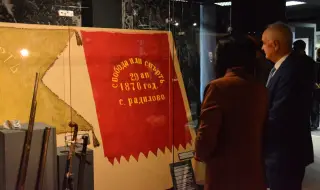
“The April Uprising marks the apogee of the Bulgarian revolutionary spirit and our desire for national freedom“. This was stated by the Minister of Defense Atanas Zapryanov at the opening of the exhibition “The Bloody Flame of the Bulgarian Easter 1876“ at the National Museum of Military History (NMMH) today, April 9. Minister Zapryanov emphasized that in the current 2026, a number of events dedicated to the 150th anniversary of the outbreak of the April Uprising (1876) will be held. In his words, such events are also important for Bulgarian servicemen: “The history of our people is what should inspire the military to protect the freedom, independence and territorial integrity of our Motherland“, he emphasized.
Minister Zapryanov thanked the museum team for dedicating an event to this glorious anniversary, and pointed out that the armed forces will participate in the national celebrations with parades and solemn events in almost all settlements where there was active activity during the April Uprising.
The Director of the National Museum of Military History and Culture, Assoc. Prof. Dr. Sonya Penkova, emphasized in her speech that the April Uprising is a serious step on the path to Bulgarian liberation. “It is no coincidence that the uprising is called the most powerful, most powerful manifestation of the Bulgarian national revolution“, she pointed out. Today, the NVIM houses the largest Bulgarian collection of personal belongings of the Bulgarian national revolutionaries of the era, the director emphasized and recalled that this is a commitment that NVIM has undertaken since its establishment.
The exhibition “The Bloody Flame of Bulgarian Easter 1876“ focuses on the original uprising flags. Among them are the Karlovo Flag – commissioned by Vasil Levski, under whose folds Panayot Volov announced the uprising in Panagyurishte, since the flag of Raina Popgeorgieva was not yet ready; three of 12 flags, sewn by order of Georgi Benkovski for the 4th revolutionary district; the flag of the Gorno-Oryahovo insurgents, detained by the Ottoman authorities before the outbreak of the uprising, but which continued its path to freedom by participating in the bloody battles of Shipka and Sheinovo in the Russo-Turkish War; the flag of Dimitar Berovski's detachment from the Razlov Uprising, which preserved the memory of the struggles in Eastern Macedonia; the flag of the Sliven Revolutionary District, of the committee in the village of Radilovo, etc. Also presented are personal weapons of participants in the uprising, national awards on the occasion of anniversaries, the international response to the events of April 1876, etc.