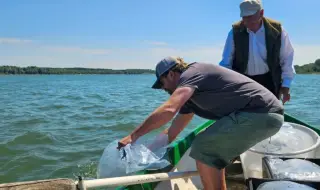
On the occasion of World Migratory Fish Day, which we celebrate this year on May 23, WWF Bulgaria and its partners released about 30,000 sturgeons of the critically endangered Russian sturgeon (Acipenser gueldenstaedtii) into the Danube. The stocking took place near the village of Gomotartsi near Vidin, where one of the most important habitats for the species is located.
The initiative is part of the international LIFE-Boat4Sturgeons project, funded by the LIFE program of the European Union. Its goal is to help restore sturgeon populations in the Danube by creating a floating sturgeon nursery in Austria, which will act as a gene bank for individuals with proven Danube origin. The fish released today were raised in this very hatchery and transported from Austria to Bulgaria. By the end of the project in 2030, 1.6 million sturgeon of all Danube species will be released into the Danube.
The event was attended by representatives of the University of Natural Resources and Life Sciences - BOKU (Austria), which coordinates the main activities of the project, as well as representatives of the Executive Agency for Fisheries and Aquaculture, the Regional Directorate for Food Safety in Vidin and the Regional Inspectorate for Environment and Water in Montana.
The Russian sturgeon was once the most widespread species in the Danube. It regularly migrated upstream, reaching Bratislava. Specimens have been spotted even in Vienna and Regensburg. Today, the Russian sturgeon is listed as critically endangered on the International Union for Conservation of Nature (IUCN) Red List.
Of the six species of sturgeon that historically inhabited the Danube, two have now become extinct – the spiky sturgeon and the Atlantic (German) sturgeon. The remaining four species – the spiky sturgeon, the Russian sturgeon, the brown trout and the brook trout – are classified as critically endangered or threatened on the IUCN Red List.
Sturgeons are among the most ancient animals on the planet. They have existed since the time of the dinosaurs and have always had significant economic and cultural importance in the countries with sturgeon populations. Today, however, the Lower Danube remains one of the last places in Europe where wild, naturally breeding populations still exist. The main reasons are poaching, habitat loss and the disruption of their migration routes by facilities such as dams and hydroelectric power plants.
WWF Bulgaria has been working for more than 15 years to protect sturgeon in the Danube through scientific monitoring of populations, stocking, limiting illegal fishing and protecting key habitats. To date, the organization and its partners have released over 130,000 young sturgeon in the Bulgarian section of the river and have contributed to the introduction of a permanent ban on sturgeon fishing in the Bulgarian waters of the Danube and the Black Sea. The organization is also working on the declaration of new protected areas. In 2022, at the proposal of WWF, a protected area was declared “Esetrite-Vetren“ – after ten years of work with local fishing communities and responsible institutions. WWF is also working to declare a second protected area near the village of Gomotartsi, which would support the long-term survival of the species.