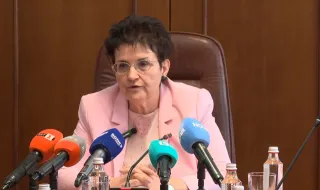
Increasing tax breaks for children and children with disabilities, a new relief for child development expenses and a higher threshold for mandatory VAT registration are among the proposed tax measures. This was stated at a press conference by Deputy Minister of Finance Lyudmila Petkova, quoted by novini.bg.
For one child, the current amount of the tax break for 2026 is 6,000 leva, and it is proposed that it be increased to 5,000 euros. For two children, the amount will increase from 12,000 leva to 8,000 euros, and for three or more children - from 18,000 leva to 11,000 euros.
For children with disabilities, the relief is proposed to be increased from 12,000 leva to 10,000 euros. According to Petkova, this is where the increase is most significant - by 3,864 euros.
A new tax relief is also planned for expenses related to the development of children. It will cover health, educational and sports activities, examples of which include fees for dances, language and other educational courses and sports activities.
For one child, expenses up to 2,000 euros can be deducted, for two children - up to 4,000 euros, and for three or more children - 6,000 euros. The condition is that the expenses are documented.
The documents will not be attached to the annual tax return, but will have to be stored and available in case of a possible inspection by the National Revenue Agency.
According to Petkova, the measure has a dual purpose - to support working parents and to contribute to the clarification of part of the shadow economy. According to her, many of the services for children are provided without issuing documents, as a result of which the income from them is not reported and is not subject to taxes and social security contributions.
Among the proposed changes in next year's budget is an increase in the threshold for mandatory VAT registration - from 51,130 euros to 75,000 euros.
The aim is to reduce the administrative and financial burden for micro, small and start-up enterprises and to create a more favorable environment for the development of small businesses.
Voluntary VAT registration will remain possible. Enterprises that are not obliged to register and do not choose voluntary registration will not be obliged to prepare and submit purchase and sales journals and VAT return statements.
The second measure is the introduction of an obligation to register for VAT on taxable supplies related to land and buildings. According to Petkova, the aim is to limit the possibilities for evasion and non-declaration of VAT.
The third measure in the field of VAT is the introduction of mandatory electronic invoicing for local supplies. According to a European directive from January 1, 2030, electronic invoicing will be mandatory for cross-border supplies, and a number of member states have already introduced such a system for domestic supplies.
The measure will be adopted now through changes to the legislation, but its actual implementation will begin in 2028. The reason is the need to build an information platform of the National Revenue Agency, through which invoices issued by suppliers will be verified. It is planned that the recipient will also confirm that the transaction indicated in the invoice was actually carried out.
Changes are also proposed in the Corporate Income Tax Act, which affect both the accounting of assets and the tax treatment of investments in new technologies.
One of the measures is an update of the value threshold for taxable long-term tangible and intangible assets. Currently, it is 700 leva and has not been changed for years. It is proposed to increase the threshold to EUR 1,000. Thus, assets worth up to EUR 1,000 will not be depreciated, but can be reported directly as an expense by the enterprise. A transitional period is also envisaged for assets worth over BGN 700 but under EUR 1,000 and already included in the tax depreciation plan of enterprises. The bill defines how they will be treated when the threshold is changed.
Among the other proposals is an increase in tax neutrality when carrying forward losses, as well as the introduction of accelerated tax depreciation for investments in artificial intelligence technologies, high-performance computing equipment and server equipment.
Changes are also proposed for electronic food vouchers. For 2026, the annual quota has been set at 818 million euros, and it is proposed to increase it to 1.5 billion euros. An increase in the maximum monthly amount of vouchers that a worker can receive is also planned. Currently, it is 102 euros, and the proposal is to reach 200 euros.
Along with the increase, it is proposed that the vouchers be taxed with a final withholding tax of 7%. With a maximum voucher of 200 euros, after tax deduction, the worker will receive 186 euros per month.
According to Petkova, the proposal was made after analyzing the practices in other member states of the European Union. Vouchers will remain exempt from social security contributions, but will be taxable at a lower rate than the standard 10 percent tax.
It is also proposed to update the regime for taxation of in-kind expenses related to own, leased or provided assets that enterprises provide for personal use to managers, partners, directors and other persons. Currently, the rate is 3%, and the proposal is to increase it to 7%.
Among the measures is the introduction of a tax on excess profits for 2027. It is proposed that such a tax be levied on the excess profits of banks, reinsurance companies, traders carrying out business activities with no less than five food trade outlets, telecommunications companies, exchange offices and payday loan companies.
For 2027, it is planned that 90% of the tax due will be paid in the form of advance payments.