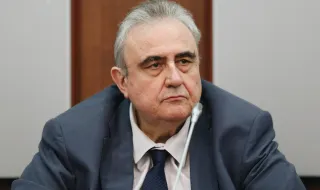
The European Council, unlike Sofia, pointed out the only possible source of the attacks on merchant ships near the Bulgarian and Romanian coasts of the Black Sea - Russia. However, no specific measures were identified after two days of meetings in Brussels this week, political scientist Prof. Ognyan Minchev stated to the Bulgarian National Radio. According to him, after two ships were sunk in just a week near Byala and Shabla, hard limits must be set on Moscow's actions, but this will be accompanied by great risks, since Bulgaria is not prepared against such a type of aggression.
"One such hard limit could be Bulgaria and Romania accepting the main Black Sea trade traffic into their territorial waters, which would expose them to direct strikes by Moscow if the drone strikes on the ships continue. Very categorical measures could be taken for collective drone defense - something that some representatives of the government and the majority here have also started talking about. But Bulgaria is desperately lagging behind in the development of modern defense technologies," Minchev noted in an interview for the program "Saturday 150".
Minchev expressed disagreement with the position that Bulgarian Prime Minister Rumen Radev expressed to his European colleagues that the biggest problem in Europe at the moment is high fuel prices, and that is why Sofia appreciates all steps that lead to their reduction.
"The biggest problem in Europe is not fuel prices, although they are a serious problem. The biggest problem in Europe is that on Putin's part, we see serious attempts to expand aggression against Ukraine, by involving in the conflict, for now through hybrid mechanisms, the periphery of both NATO and the European Union. That is, Putin's attempts to enter into direct conflict with the countries of Eastern Europe, with NATO and the EU as a whole."
According to Minchev, the leader of Russia and his American counterpart Donald Trump "greatly underestimate" Europe's capabilities and this will fail their cooperation.
"They imagined that they would be able to crush Europe very easily, to remove it from the scene, since it had not been a significant geopolitical factor for a very long time. Europe's entry onto the geopolitical scene is an unpleasant surprise for both Moscow and Washington. An unpleasant surprise that will block any attempts to circumvent the conflict between the West and Russia - a confrontation that Trump is trying to circumvent through speculative steps like the diesel deal or like what he did last night. In practice, he suspended part of the Graham Act, which he signed just a month ago, and expanded Putin's ability to sell oil on the international market."
The midterm elections for the US Congress on November 3 will weaken the attacks of the Washington administration against Europe, Ognyan Minchev predicts.
"Whether the midterm elections will deprive Trump of a significant part of his prerogatives due to a new balance between the White House and Congress, or simply the growing political opposition in the US will reduce the scope of the real impact that decisions in Washington have on the international environment, one way or another this type of negative-hybrid impact on Europe and on Ukraine, at least as far as the US territory is concerned, will be reduced."
The reaction of President Trump and his entourage after the expected defeat in the elections hides certain risks, the political scientist warned, recalling the storming of the Capitol by angry supporters of MAGA after Trump's electoral defeat by Joe Biden.
"We know what happened on January 6, 2021, and we know that the results of the midterm elections can lead not only to a decrease in the relative weight of the White House in American domestic and foreign policy, but also to strong tension and extremism of political mores in the United States. Which will ultimately lead to a decrease in the chances of the United States to play a leading role in international relations."