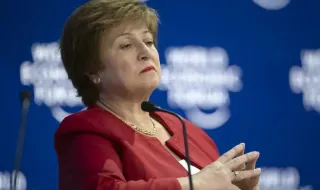
“Don't spend money you don't have.“ This is the message of the Managing Director of the International Monetary Fund Kristalina Georgieva to the Bulgarian government. In an interview for the program “120 Minutes“ on bTV, she commented on the country's budget, the global economy, the energy crisis and the impact of artificial intelligence on growth and the labor market.
According to Georgieva, the IMF forecasts global economic growth of 3.1% for this year. However, behind this forecast are two opposing trends.
“One is the energy shock - it is pulling growth down. The other is investments in artificial intelligence - they drive growth up,“ she explained.According to Georgieva, a relatively small number of countries are raising their growth forecasts because of their participation in the development of artificial intelligence. The larger group of countries is facing lowered expectations, as it is not sufficiently integrated in this industry and depends on oil and natural gas imports.
Risks facing the global economy
Georgieva warned that inflation continues to be a problem, and high indebtedness limits the capabilities of a number of countries. She defined the global economy as dependent on one main driver.
„We see a global economy that has stepped on one foot - artificial intelligence. If there is disappointment, if someone pulls the chair, we could find ourselves in a difficult position“, she said.The fund's forecasts are based on assumptions about the development of conflicts and the restoration of shipping. In the event of a new escalation in the Middle East or other conflict regions, the economic consequences could be more severe than those set out in the base scenario.
Europe has reduced its dependence on Russian oil and natural gas after 2022, but remains vulnerable to high energy prices. According to Georgieva, the European Union's problems include the incomplete integration of the single market, lower labor productivity and lagging behind the United States in the field of artificial intelligence.
She pointed out that facilitating investment, a more efficient common labor market and the integration of energy systems could improve Europe's competitiveness. According to her, this would reduce energy prices by more than 10%.
Warning for the Bulgarian budget
Regarding public finances, Georgieva reported a positive change in the government's intentions. According to her, the cabinet has the will to propose a budget in which the deficit will be reduced to 3% over the next two years.
„There is a positive development. The government has the will to propose a budget in which the deficit will fall to 3% over the next two years. That is, we are reducing spending on money that we do not have“, Georgieva pointed out.However, she warned that the measures to increase revenues appear to be mostly one-off, and the plan to limit spending is not clear enough. In order to sustainably reduce the deficit, she said, permanent and systematic revenues are needed to provide buffers against future economic shocks.
Georgieva called for investments that can increase labor productivity not to be affected by spending cuts. She noted that incomes in Bulgaria continue to grow, but this is not accompanied by a corresponding increase in productivity.
“In our country, wages are growing, which is a very good thing, but the problem is that they are growing without labor productivity growing“, she emphasized.When asked whether the IMF is insisting that Bulgaria abandon the flat tax, Georgieva replied that the fund does not specifically set such a requirement. She called on the government to review its tax policy, emphasizing that the decision is in its hands.
According to Georgieva, reducing the deficit should not be based solely on temporary measures. She linked the possibility of a higher standard of living with the building of a strong economy based on high labor productivity.
Sources: btvnovinite.bg