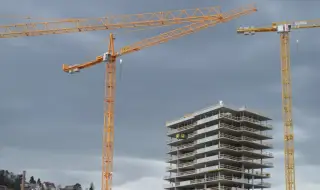
The largest construction companies in Germany continue to increase their scale of operation despite the weak housing market, the rise in bankruptcies and the pressure on smaller companies in the sector. The market is increasingly divided between large international groups and medium-sized companies that struggle with high costs, uncertain orders and difficult access to financing.
Hochtief from Essen remains the leader in the ranking. The company increases its total construction output for 2025 from 33.3 billion EUR to 38.4 billion EUR, which is an increase of 15.1%. Thus, the German construction giant widens its distance from other participants in the sector.
Strabag remains second in importance, if the entire German portfolio of the Austrian group is taken into account. It also includes Züblin from Stuttgart, which alone realizes an annual production of EUR 4.775 billion. In total, Strabag reaches EUR 13.7 billion in revenue in Germany, with over two-thirds of the group's total activity coming from the German market.
Serious pressure on the leading positions is also being exerted by the German division of the French Vinci. The company reports growth of 16.8% to EUR 6.485 billion and is now very close to Goldbeck from Bielefeld. If this trend continues, three of the leading companies in German construction could be subsidiaries of foreign groups in the next ranking.
Germany remains the largest economy in Europe, but the construction sector is increasingly dominated by large groups with international capital, access to large infrastructure orders and the ability to take risks in segments such as data centers, energy infrastructure, railway projects and industrial construction.
The problem is that this picture does not automatically mean a recovery in housing construction. It is the housing sector that remains the weakest part of the market. High construction costs, more expensive financing and uncertainty about sales prices continue to stop many projects. Therefore, large construction companies are turning to segments where demand is more certain and financing is more stable.
The clearest example is Hochtief. Although the company tops the overall ranking, only a small part of its activity actually comes from Germany. In terms of construction output on the German market alone, Hochtief is only in 12th place with EUR 1.151 billion. At the same time, the group benefits from its international presence and strong subsidiaries in the USA and Australia.
In Germany, Hochtief is already increasingly focusing on data centers. In Heiligenhaus in North Rhine-Westphalia, the first Yexio data center, built with a modular solid wood structure, will be put into operation in 2025. Another 14 such sites are under construction or in the planning stages. At the beginning of July, the company also announced a major contract for a 36-megawatt data center in Berlin for NTT Global Data Centers. The first halls are due to be ready in 2028, and the entire project — in 2029.
This shows the new direction of the construction market: while residential construction remains under pressure, digital infrastructure, energy projects and large public procurement are becoming growth drivers. For property investors, this is an important change, because capital is being redirected from classic residential projects to specialized assets with long-term tenants and more predictable cash flows.
At the same time, the sector remains highly vulnerable. According to the ranking data, bankruptcies in the main construction sector in Germany increased by 7.4% in 2025, and in the entire construction economy, including craft companies, the increase reached 10.1%. This shows that the crisis is mainly affecting smaller players, which do not have the scale and financial backing of large concerns.
Among the fastest growing companies in the mid-market segment are Friedrich Vorwerk, Bickhardt Bau and Terras Group. Friedrich Vorwerk increased its volume by 43.8% to EUR 734 million, Bickhardt Bau reported growth of 46.1% to EUR 646 million, and Terras Group reached EUR 485 million after a jump of 191.6%. Terras is developing through acquisitions in infrastructure construction and is now part of a strategy financed by private equity.
There are also losers. Bauer from Schrobenhausen drops out of the Top 10 after its construction output fell by around a fifth to EUR 1.7 billion. The company has gone through management turmoil and a change of ownership, which shows how difficult the situation remains even for familiar names in the sector.
The ranking outlines a construction market in which scale, access to capital and specialization are becoming decisive. Large companies are growing because they can take on complex infrastructure and technology projects. Smaller companies are under pressure from costs, bankruptcies and shrinking housing construction.
For the property market, this means that the recovery will not be uniform. Residential construction will remain sensitive to interest rates and purchasing power, while industrial properties, infrastructure sites and data centers will continue to attract the most serious interest from large construction groups.
Detailed statistics on average property prices in Bulgaria by city and neighborhood can be found at imot.bg