For more than three years, Ukraine has been waging an almost daily battle against Russian attack drones. Last week, NATO got a first-hand look at this. On the night of September 9-10, amid a massive Russian air attack on Ukraine, Polish authorities reported detecting 19 violations of Polish airspace, prompting a multi-million dollar response, with fighter jets scrambled and Patriot air defense systems put on alert. Poland shot down the drones with the support of warplanes from its NATO allies.
The violation of Polish airspace, which lasted several hours, exposed NATO's vulnerability when it comes to drone warfare. Russian officials stressed that they had not attacked Poland, while Belarus, a close ally of Moscow, said some of the drones "lost their course" because they were jammed. However, a number of European leaders and experts have said that Polish territory was deliberately attacked.
If one or two drones had crossed into Polish airspace, it could have been due to a "technical malfunction", but "it would be hard to believe it was accidental" when it comes to 19 unmanned aerial vehicles, said Polish Foreign Minister Radoslaw Sikorski.
While it is difficult to prove intent, "when several have strayed, it starts to look more like deliberate", agreed Thomas Whittington, an expert in electronic warfare at Britain's Royal United Services Institute (RUSI), the oldest defense and security think tank. According to him, the goal may have been to test the alliance's response and its ability to respond to the drones.
Confusion and Suspicion
Since the beginning of the year, Russia has used at least 35,698 attack drones against Ukrainian territory, according to an AP analysis of data from the Ukrainian Air Force.
Polish airspace has been violated repeatedly since the start of Russia's full-scale invasion of Ukraine in February 2022. Debris from Ukrainian missiles killed two people in Poland in 2023, and drones have repeatedly changed course and deviated towards Poland, Romania, Moldova, as well as the Baltic states – Lithuania, Latvia and Estonia.
Until last week, however, no NATO member had suffered such repeated violations of its airspace. It was the first known case since Russia’s war in Ukraine that the alliance’s air power had been used against enemy targets in the airspace of a NATO member.
Destroyed drones were found 554 kilometers (340 miles) into Polish territory – further than any previous incursion.
Much remains unclear, and NATO is for now remaining cautious. "We still don’t know whether this was intentional or unintentional," said General Alexis Grinkiewicz, head of US European Command (USEUCOM) and Supreme Allied Commander Europe.
"Without solid evidence" It's hard to say whether Moscow really intended to send drones into Poland, said Ash Alexander-Cooper, a former military commander and vice president of Dedrone by Axon, a company that makes technology to detect and neutralize unmanned aerial vehicles.
But based on what is known about Russian drones and how they react to electronic warfare, experts the AP spoke to said it's highly likely the incursion was intentional.
Electronic warfare
There are two main ways to neutralize more drones: shoot them down or interfere with their signals.
Jamming and spoofing are the main ways to disrupt signals. Jamming is done by sending a strong radio signal that cuts off communications with the drone, while the other method - spoofing - The signal to the drone is spoofed so that its receiver is fooled into thinking it is flying over a different location than the one it is actually flying over, the AP notes.
If the drone is jammed – from Ukraine or Poland – it will land or return to its starting point in Russia or Belarus, Whittington said. However, if the signal is spoofed, the drone could go off course, crash or land.
If the signal to the drone is tampered with, trying to jam it could actually "make the problem worse," says Alexander-Cooper. Jamming a drone usually sends it back to base, but Russia is now programming some drones so that their "base" is actually their target. That is, even if satellite communications are interrupted, the drones continue on their course towards their assigned targets.
Military drones also have inertial navigation devices that use previous positional fixes and gyroscopes to mark the location of the unmanned aerial vehicle relative to the ground so that it can continue to fly without satellite or radio signals.
In such a case, the drones could only penetrate deep into Polish airspace if Russian forces had given them a targeted "mission", Whittington stressed.
Fighters worth millions and cheap drones
The attack drones used by Russia, known as "Shahed", "are difficult to fool" by means of electronic warfare, Alexander-Cooper said, which is why NATO sent planes to shoot them down.
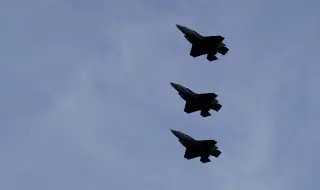
Poland and its allies used F-35 and F-16 multi-role fighter jets, as well as UH-60 Black Hawk helicopters and Soviet Mi-24 and Mi-17 helicopters to deal with the incursion, the Polish Defense Ministry said. American Patriot air defense systems from the Bundeswehr (German armed forces) were also put on alert.
Alexander-Cooper argued that the NATO allies' response was economically disproportionate to the threat. "Launching missiles worth millions of dollars is not an economically sustainable model." to deal with drones that cost tens of thousands of dollars, he said.
The Chief of the General Staff of the Polish Armed Forces, General Wiesław Kukula, told Polish television that the price was irrelevant. "What matters is how much this drone can destroy. If it is a Pole's life, it is priceless," he added.
Lieutenant General Andrus Merilo, the commander-in-chief of the Estonian Armed Forces, told the AP that it was important to pay attention to "what targets we are protecting", not what is attacking them. Drones may be cheap, but the cost of a missile to repel them could be far outweighed by the damage they could do.
If we were to face swarms of drones like those in Ukraine, there would not be "enough aircraft in NATO with enough missiles or enough interceptors to deal with the task," Alexander-Cooper stressed. That would also require putting fighter pilots, who are in short supply and expensive to train, at risk, he added.
Both Russia and Ukraine have rapidly developed new drones, technologies and tactics. Since 2024, Russia has been using decoy drones without payloads alongside attack drones to overwhelm Ukrainian air defenses, which have difficulty distinguishing between them. Russia has the ability to link several drones together to travel in a column, in order to reflect the signal and increase the range of another drone, says Fabian Hintz of the International Institute for Strategic Studies (IISS) in London.
On the front line, both Russia and Ukraine use fiber-optic drones for surveillance and strikes. They are immune to electronic interference because they are connected to the operator by a long and very thin fiber-optic cable.
NATO against drones
NATO's current air defense systems are designed primarily to detect and neutralize fast-moving targets such as cruise and ballistic missiles, says Whittington. They are not designed to track the movements of small drones, often made of fiberglass or plastic, which do not reflect radar waves in the same way as missiles, he added.
Last week, Polish Foreign Minister Radoslaw Sikorski said that Poland needed a "wall of drones" and "new techniques" to repel a possible massive attack.
No one was killed, so it would be wrong to say that NATO's response was a "failure," Whittington said. But "it could have been much more serious. I am concerned, however, that next time it could be," he stressed.
Translation from English: Simeon Tomov, BTA