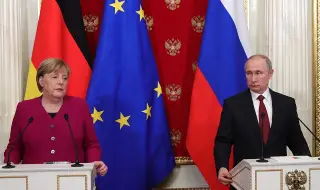
Did Angela Merkel really say that Poland and the Baltic countries bear "part of the blame" for the war in Ukraine? What is hidden behind the headline of the German "Bild" and what did the former Chancellor actually say in Hungary?
"Merkel gives Poland part of the blame for Putin's war" - an article with this loud and resonant title appeared yesterday on the website of the famous German tabloid "Bild". The source – interview with former German Chancellor and former leader of the CDU Angela Merkel, given to the Hungarian portal “Partizan“.
Has Merkel really revealed anything new about Russia's war against Ukraine that she has been silent about until now? The 47-minute interview, which is available on YouTube in its German original, does not provide grounds for such conclusions. And the most important thing, which is also stated in the title of “Bild“ - namely the phrase “part of the blame“ - is actually not present in Merkel's statements at all. This is an interpretation of her words by the author of the article, as is clear from the subtitle - that these are “indirect“ accusations.
What is Merkel actually saying
What is Merkel actually saying? “In June 2021, I felt that Putin was no longer taking the Minsk agreements seriously.“ Against this background, she called for the creation of a “new format“ with the participation of the EU, so that “we as the EU could speak directly to Putin“. The proposal came as a surprise to many, because they perceived it as an idea to resume summits between the EU and Russia. These meetings were suspended in 2014 after Russia annexed Crimea. That is why the idea, put forward by Merkel and French President Emmanuel Macron, did not receive support at the EU summit.
“Some countries did not support it - these were mainly the Baltic countries, but Poland was also against it”, Merkel told “Partizan“. According to her, opponents of the initiative were afraid that the EU did not have a unified policy towards Russia. Merkel adds that her intention was driven by the need to establish a unified position, which, however, never happened - her term of office ended soon after, and Russia's war against Ukraine, for which Merkel repeatedly accused Moscow during the interview, began six months later. Merkel does not speak about this literally, but her words can be interpreted as follows: in her opinion, the new format for negotiations with Putin could have been a chance to prevent a future war. However, whether this chance was even real is something we will never know.
Why the proposal was not accepted
At that time, Ukrainian President Volodymyr Zelensky criticized Merkel's proposal, calling it "unfair". All this is happening against the backdrop of fears of a large-scale Russian invasion of Ukraine, which emerged in the spring of 2021. At that time, Russia massed troops along the Ukrainian border, then withdrew them only partially. And Merkel is a leader whose political weight in Europe and the world was weakening at the time - there were only a few months left until the next Bundestag elections in Germany, for which Merkel was no longer running.
Since then, Merkel's views on Russia have apparently not changed. She is convinced that her actions were correct and she has nothing to apologize for, which she notes in her memoir. Merkel once again reiterates her repeatedly stated thesis that the Minsk agreements, although violated by Russia, nevertheless provided Ukraine with a certain reprieve.
And what is the former chancellor silent about?
Merkel continues to believe in the power of diplomacy, as she once again says in the interview for “Partizan“ - her opinion is that the approach to Moscow should include forceful deterrence, but also diplomacy. However, she is silent on the fact that US President Donald Trump's recent diplomatic efforts and the restoration of contacts with Putin have not stopped Russia's war against Ukraine.
Merkel also fails to mention that before the Russian invasion of Ukraine there were many contacts, but without Zelensky, with whom Putin refused to meet after December 2019, when talks were held in Paris in the so-called “Normandy format“ (Germany, France, Ukraine and Russia). Western leaders, including Olaf Scholz, Merkel's successor as Chancellor, have met with the Russian president. In 2021, Putin also met with US President Joe Biden in Geneva, as well as talks at the Russia-NATO and Russia-US levels - and this was just weeks before the Russian invasion of Ukraine.
Lack of personal contacts with Putin?
Merkel's claims that the war may have been influenced by the absence of personal contact with Putin, rather than by video link, as was the case during the pandemic, are not new either. In the interview with “Partizan“ Merkel gives as an example the fact that in October 2021 Vladimir Putin did not come to the G-20 summit in Rome, citing the risks associated with the coronavirus. However, she fails to mention that around the same time Western intelligence agencies had already begun to register Russia's preparations for a large-scale invasion of Ukraine.
In general, Merkel is not saying anything new, her position on Ukraine is consistent with what Scholz has said more than once: “Russia should not win the war, and Ukraine should remain a sovereign, free state“.