Author: Emilia Milcheva
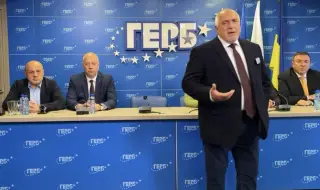
With a speech at GERB headquarters on Tuesday, leader Boyko Borisov reformatted the political agenda. Then Prime Minister Rosen Zhelyazkov canceled the government meeting, and today the parliament did not gather a quorum - and called for early elections.
Is he leaving GERB
The monologue in front of the cameras, reinforced by the effect of an angry Borisov walking back and forth, comes down to one sentence: "We will not tolerate any more". But besides this "will not" there are many questions: Who will he not tolerate - the voiceless small coalition partners or Delyan Peevski? Did Peevski officially invite them to share power or is he buying time? Will he get by with cabinet changes such as changing the leadership of the Ministry of Interior and BSP ministers or is this cosmetic work just noise due to the strong shortsightedness about the election violations in Pazardzhik and personnel changes in places?
The 25-minute scene was not a spontaneous outburst, but a tactic of a former political powerhouse. Borisov directed his own downfall, as he understands well that GERB will bear the damage from the government. In normal democracies, problems in the coalition are first discussed at a coalition council, and then the solutions are presented to the public - personnel changes or the resignation of the government and new elections.
In Bulgaria, the leader of the party with whose mandate he governs the government put on a show that was a demonstration of control, not political responsibility. He humiliated and insulted the prime minister, nominated by GERB, the minister of interior, nominated by GERB, the speaker of parliament, nominated by the coalition partner BSP, and the Joint Governance Council - which is supposedly the coalition body where decisions should be made.
BSP cautious, MRF-NN waiting for an invitation
By the end of the day, the only political reaction was from Delyan Peevski, who was sanctioned for corruption by the US and UK - that MRF-New Beginning is ready to take responsibility for governing Bulgaria and will send a negotiating team. This is how Peevski interpreted the reformatting, but without mentioning early elections. Despite the proclamations about the strength of his party, he prefers exactly this format of governance - a new vote would disrupt this comfort.
BSP is fighting to retain governance. Despite the slightly encouraging results of the elections in Pazardzhik, the "Positano" 20 understand that they are dancing the last waltz in power. "Our categorical position is that a new political crisis would have a destructive effect on social peace and key systems in the state. As well as that it would question what the government has achieved so far", the socialists state in their position. The national populists from the pro-Russian "Vazrazhdane" are counting on Borisov's speech as a sign for elections. "Borisov made a clear statement that GERB will leave the government. He knows that there are only two options - either new elections, or within a year he will be Mr. Nobody", Kostadin Kostadinov wrote on Facebook.
Heat around the corner
The GERB leader has reasons to overthrow the government, which governs with his party's mandate and which Peevski weighs more on than stabilizes. GERB's sixth place in the extraordinary elections for municipal councilors in Pazardzhik is just a pretext. GERB did not have strong positions in the municipality, which was governed for 16 years by Todor Popov with his business circle. He, on the other hand, got along very well with Borisov and Peevski. In 2023, the party, although third, had four councilors, now it is in sixth place with three. In 2019, however, GERB won 9 seats, while MRF managed to take only one.
Now Borisov is putting into action the tried and tested trick of overthrowing himself from power from his first two terms as prime minister. This shows that he, and not someone else (for example, Peevski), holds the reins. "Peevski is not in government - or should he officially enter. Whatever they say there to the Joint Governance Council, I will judge for GERB whether it is right or not." GERB has governing bodies that decide whether to let Peevski through the front door. And it was Borisov who let him through the back door.
Tensions are rising, and as a political veteran, the GERB leader feels it from afar. Budget 2026 has drawn serious criticism from business due to inflated wage costs and unrealistic revenue forecasts. And after January 1, when Bulgaria will officially be part of the eurozone, the threat of protests over higher inflation will remain for the caretaker government.
If the current coalition cabinet falls, the roulette wheel will spin again and GERB, as the first political force, will negotiate to form a government first with the second in the person of PP-DB. The chances of such a government, however, are minimal - the distrust between the two formations is deep, and public tolerance for a new "assembly" - exhausted. In such a scenario, early elections will look not like a failure, but like a controlled withdrawal. Their scheduling would be with the first storks next spring. This will be done by President Rumen Radev and his party's "ΙPΟ" (initial offering of shares of a company on the stock exchange, b.a.) half a year before the presidential vote, but politics is not a game with rules.
Only Natalia Kiselova remained
But before that, Borisov "ordered" to replace the Speaker of Parliament Natalia Kiselova, nominated by the BSP. According to the Constitution, the parliamentary boss is the first in the house book from which caretaker prime ministers are chosen. And Kiselova is the last name there, which is not a selection by Borisov/Peevski.
The other is the Deputy Governor of the Bulgarian National Bank Andrey Gyurov, for whom a large panel of 15 judges headed by the President of the Court of Justice of the European Union (CJEU) Kuhn Lennarts will meet in November. They must rule on the case that the Supreme Court of Appeal sent to them - whether to overturn the decision of the BNB Governing Council that there are grounds for his dismissal as deputy governor.
Who will fall from the back
Borisov ordered his deputies to return to the regions to check "how much has been eaten" (not that he doesn't know). That is, how many have left GERB, such as the leader of the list of municipal councilors of the DPS-New Beginning in Pazardzhik Desislava Todorova, a former GERB MP. If there is anything eaten and spoiled, we will go to elections, he threatened.
The GERB leader has no illusions that if Peevski officially enters the government, this will accelerate his political demise - both domestically and in foreign policy. So far, he has been getting away with a "soft inclusion" of a de facto, not de jure partnership. An offer of post(s) to Delyan Peevski will certainly unleash protests, and Boyko Borisov is not a political suicide bomber.
The attempt to lift the "Magnitsky" sanctions by "his close allies", revealed by the Wall Street Journal, failed. Marked with them, Peevski is toxic for a partner and GERB's political family - the European People's Party (EPP), which had a hard time swallowing the government with "United Patriots" in 2017, would not support Borisov for such an undertaking.
While Peevski offers him short-term stability at home, Borisov will lose legitimacy abroad, and with it the political umbrella from Brussels in case of possible domestic crises. In recent months, Brussels and the EPP have been providing strong support, which is evident in the acceleration of funds for the second tranche of the Recovery and Resilience Mechanism and the renegotiation of some of the reforms under the national plan.
Sarafov as Geshev?
There is one figure who could be swallowed up in the upcoming turbulence - acting Prosecutor General Borislav Sarafov. A symbol of compromise, he was elected temporary prosecutor No. 1 in June 2023, when the PP-DB cabinet was formed, supported by GERB-SDF, as well as the MRF. But before that, it became clear that the then Prosecutor General Ivan Geshev, whose deputy he was, was leaving. The Supreme Judicial Council, whose term expired in 2022, dismissed him early from office - the formal reason was his expression "the political garbage in the National Assembly".
How long Sarafov will remain in office depends on political calculations. If the balance tilts towards new elections and a reformatting of power, Sarafov may turn out to be the next sacrificial pawn, like Geshev in 2023. The prosecutor's office remains a key element in the architecture of power - a tool for control and clearing the field.
Borisov's balance sheet after 10 months in power sounds like a warning, not a report. "The red light is on, what awaits us from all this", says the party leader, who often says that he has sacrificed himself (because he is not prime minister), as well as the party, for a government that is not stable. His speech shows the old reflex of presenting himself and GERB as the last pillar of statehood, without which the government collapses. But behind this narrative lies not confidence, but fear that control is slipping away.
The reformatting has begun. And Peevski is waiting for an invitation.