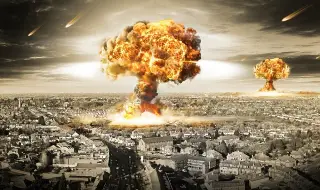
US President Donald Trump has ordered the US military to immediately resume its nuclear weapons tests after a 33-year hiatus, minutes before the start of his meeting with Chinese leader Xi Jinping.
How many nuclear weapons tests have been conducted in the past, why were they suspended and why would anyone want to resume them? Reuters answers these questions.
The Nuclear Age
The United States ushered in the nuclear age in July 1945 with the testing of a 20-kiloton atomic bomb in Alamogordo, New Mexico, and in early August of that year dropped atomic bombs on the Japanese cities of Hiroshima and Nagasaki to force the Japanese Empire to surrender at the end of World War II.
The Soviet Union shocked the West when it detonated its first atomic bomb just four years later, in August 1949.
In the five decades between 1945 and 1996, when the Comprehensive Nuclear-Test-Ban Treaty (CTBT) was signed, more than 2,000 nuclear tests were conducted, 1,032 of which by The United States and 715 from the Soviet Union, according to UN data.
The United Kingdom has conducted 45 tests, France 210, and China 45.
There have been 10 nuclear weapons tests since the Comprehensive Nuclear-Test-Ban Treaty came into force. India and Pakistan conducted two each in 1998, and North Korea conducted one test each in 2006, 2009, 2013, two tests in 2016 and another test in 2017, according to the UN.
The United States conducted its last nuclear test in 1992, China and France in 1996, and the Soviet Union in 1990. Russia, the successor state to the USSR and inheriting most of the Soviet nuclear arsenal, has never tested a nuclear weapon.
Last week, Russia held a strategic nuclear force exercise and tested a nuclear-powered cruise missile and an unmanned underwater torpedo with a nuclear engine, but no tests of a nuclear warhead.
Why were they suspended? nuclear tests?
Concern about the impact of tests - aboveground, underground and underwater - on human health and the environment is growing.
The impact of Western nuclear tests in the Pacific Ocean and Soviet nuclear tests in Kazakhstan and the Arctic has been significant on both the environment and people. Activists say that the lands of millions of people living on islands in the Pacific Ocean and those living in Kazakhstan have been contaminated by nuclear tests and that people there have suffered health problems for decades.
According to activists, limiting nuclear tests during the Cold War could reduce tensions between Moscow and Washington.
The Comprehensive Nuclear-Test-Ban Treaty prohibits the detonation of nuclear bombs by anyone, anywhere. It was signed by Russia in 1996 and ratified in 2000. The United States also signed the treaty in 1996 but never ratified it.
In 2023, Russian President Vladimir Putin officially revoked his country's ratification of the Comprehensive Nuclear-Test-Ban Treaty, bringing his country into line with the United States.
Why would anyone resume nuclear testing?
To gather information - or to send a signal. Nuclear tests provide evidence of what each new nuclear weapon is capable of - and whether older weapons are still functional.
In 2020, the Washington Post reported that the Trump administration had discussed whether to conduct a nuclear test. In addition to providing technical data, such a test would be perceived by Russia and China as a deliberate attempt to demonstrate US strategic power.
Putin has repeatedly warned that if Washington resumes its nuclear tests, Russia will do so too. Putin claims a global nuclear arms race is already underway.
What are the great powers doing with their nuclear weapons?
The exact number of nuclear warheads each country possesses is a secret, but according to the Washington-based Federation of American Scientists, Russia has a total of about 5,459 nuclear warheads, and the United States about 5,177. These numbers include deployed nuclear warheads, those in storage, and those that have been decommissioned.
For its part, the Arms Control Association says the United States has 5,225 nuclear warheads, and Russia has 5,580.
The world's stockpiles of nuclear warheads peaked in 1986 at a total of more than 70,000, most of them in the Soviet Union and the United States, but since then the number has their number has decreased to about 12,000, with more of them still located on the territory of both countries.
China is the third largest nuclear power with 600 nuclear warheads, France has 290, Britain has 225, India has 180, Pakistan - 170, Israel - 90, and North Korea - 50, according to data from the Federation of American Scientists.
Russia, the United States and China have recently undertaken large-scale modernization of their nuclear arsenals.
Translated from English: Simeon Tomov, BTA