Comment by Veselin Stoynev:
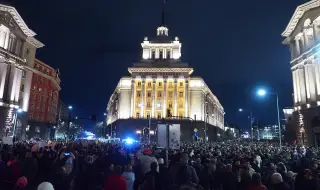
After the protest of thousands in Sofia on Wednesday, which led to the withdrawal of the draft state budget, we now have a qualitatively new political situation. For both the ruling party and the opposition, the political dynamics and prospects now have completely different dimensions.
What the protest showed
1. The protest showed rising intolerance and determination, to the point of readiness for radicalization, against a government that goes too far with unforgiveness and overindulgence in illegitimate power. The budget was only an occasion for this resentment, which could unleash a whole wave of protests. With its victory on Wednesday, the protesting citizenry is now charged with faith in its own strength and an appetite for a new outburst, which can be unleashed with even greater force at every new opportunity.
2. The protest made a serious statement that the youngest Bulgarians are now eager to actively engage in civic and political actions. A significant share of the protesters were people aged 20-30, among whom some were newcomers to Sofia (Sofia is Bulgaria, contrary to the cliché that it is not). The protesting person is beautiful, as Georgi Gospodinov wrote 12 years ago - and this was evident on Wednesday at Largo.
3. Despite the expanded fan - with sympathizers and political figures outside the democratic opposition, represented by the PP-DB, who wanted to join, the protest remained entirely a protest of the urban democratic community in its nature and appearance. It cannot be compromised or co-appropriated by "kopeks", "swords", "skulls", etc., insofar as the presence on the square of representatives of such formations and personalities was unwanted or barely tolerable, and their sympathizers became a subordinate part of the general civil-democratic pathos.
4. PP-DB in their criticism of the budget targeted the middle class and business as the victims and thereby consolidated a social base both for their battle for the budget and as a long-term request to be the exponents of the interests of these social groups. The initial success of this strategy was seen at the protest. Civic activists, representatives of business associations and professional classes raised a common voice as the main creators of the goods in the country, which someone else appropriates and arbitrarily distributes. And the leaders of the PP-DB, Asen Vassilev and Ivaylo Mirchev, have also established themselves as leaders of the protest, managing to protect it from serious excesses and provocations.
How are the ruling parties reacting
Boyko Borisov's retreat with the withdrawal of the budget so far looks like a return to the old Borisov, who always backs down during protests in order to limit political damage and then restore his power. He once again looks like the man driving the train, the question is whether this will only be until the next station. And will Delyan Peevski allow him to do anything other than a tactical maneuver or will he directly hit him with his institutional clubs?
At first, Peevski threatened to withdraw the BSP from the coalition in the event of a serious budget reform (the BSP led by Atanas Zafirov is for DPS-New Beginning what Rumen Hristov's UDF is for GERB). However, Borisov will find it increasingly difficult to maneuver between Peevski and the civil-political opposition to the government. Although there are also trump cards to lean on Peevski - such as not voting on the budget at all and spending half a year, for example, with 1/12 for each month of the current budget, which will freeze the inflated expenses and the increase in tax and social security rates. Even GERB may not vote for Peevski's candidate for head of DANS, Denyo Denev, as the opposition wants. Similar moves will also reveal whether Borisov still controls his parliamentary group and to what extent it has been taken over by Peevski, as the opposition has long claimed.
A partnership between PP-DB and Borisov's GERB is impossible
For the protesters and PP-DB, however, Borisov and Peevski are one and it will take a very long game of proving that the former prime minister is fighting to free himself from Peevski and that they are no longer a tandem. But even if Borisov were to fall into the role of Peevski's victim, like Dogan, this would not rehabilitate him in their eyes so that he could once again be perceived as a potential partner. The prospect of a partnership with GERB now seems possible only as GERB without Borisov. And this now raises the question of Borisov's party legacy and to what extent GERB can be a significant factor without him.
Therefore, Borisov's real retreat may only be strategic - in which he uses the protest energy and Peevski's assertiveness to relentlessly move forward and crush, so that at some point the government can fall, for which he is not responsible. This way he will free himself from Peevski, although GERB will also suffer serious damage. But this seems to be the only sure way to avoid finally and irrevocably sinking into Peevski's embrace. This move goes through a new political configuration after the elections, in which GERB will either be in opposition or only the runner-up of a new government.
Who is counting on what if there are early elections
Borisov's immediate problem is clearly whether to contain a wave of protests from causing early elections before the presidential elections, when Rumen Radev would most likely also appear on the party field, or to see a chance in the early elections to get rid of Peevski - in a parliament with a completely new configuration, in which, however, his party will most likely be a secondary force. For the PP-DB, the question is whether they will manage to assert themselves as the main exponents of the rising dissatisfaction with the ruling party before possible early elections and thus prevent the possibility of Radev becoming the big new governing alternative. Or will Radev turn out to be the big winner of the vote.