Daniel Smilov's comment:
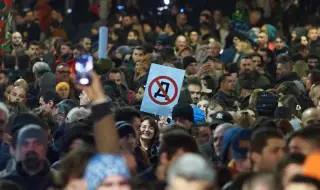
What happened this week is the return of the Protest with a capital "P" . The occasion was the submitted and voted on first reading of the country's budget. However, the reason was different, namely the rampant capital "D" of the state.
The Peevski-Borisov tandem, in which Borisov increasingly looks like a spare wheel, has sunk into managerial self-oblivion . An incredible mess reigns in the judicial system, with the acting prosecutor general being practically an illegal usurper, and the governing bodies of the magistrates are about to complete second extraordinary and unconstitutional mandates. Bulgaria will probably lose over 200 million euros from the Recovery and Resilience Plan (RRP) simply because of the tandem's unwillingness to make the anti-corruption commission at least a little independent of its wishes. Blago Kotsev and other political prisoners spent months in detention and prison without reason as a demonstration of the duo's repressive power (and on this issue Borisov played more like second fiddle). To top it off, the tandem finally went on to adopt a budget of an unprecedented 46% of GDP, which would increase the country's debt to 35% of GDP in a short time. At the same time, they reneged on their promises that they would not raise the tax and social security burden. And as the only justification for their budget orgy, they pointed to another person - Asen Vassilev - whose budgets, however, allocated less than 40% of GDP with a 24% public debt and without raising taxes and social security contributions.
From this point of view, the return of the Protest was both justified and even a little late. After all, in recent decades, the Protest has turned out to be the last form of constitutional restriction of disintegrated political majorities. This is not the most effective form in a constitutional democracy, but when others are ignored, it also works.
The Protest is not, in principle, just a party event. It is true that the PP-DB and their sympathizers were a major part of what happened on Wednesday, and the leaders of the coalition were accepted and welcomed by the protesters. But this Protest was both spontaneous and unorganized by party cores. It attracted many young people who do not have clear political affiliations. In this sense, he is indicative of the general mood, if not in the country, then among the more active part of society. There will be much debate about his legitimacy, but in the end it will still become clear that he is the expression of the opinion of large majorities.
That is why Borisov backed down so quickly. Perhaps in his maneuvers there is also a desire to distance himself slightly from Peevski, but these Borisov's desires are so timid and shy that they should be left for analysis by subtle psychologists. Ultimately, with all his actions over the past year, Borisov has aimed and succeeded in getting Delyan Peevski into his government. And as has been said, people judge them by their deeds, not by their psychological trepidations.
The other line along which the Peevski-Borisov tandem backed down slightly is the "release" from arrests of political prisoners: both Blago Kotsev and Nikola Barbutov. The arguments for these decisions were obviously not only legal, because these arguments existed months ago, and the courts ruled differently. The magistrates simply did not notice the sound legal logic, and now in one week, almost simultaneously, they appreciated it. Such "miracles" exist and are called "political control over independent bodies". It is good that the two political prisoners were released. The bad thing is that Bulgaria does not have an independent judicial system, although individual magistrates (perhaps the vast majority) are honorable people. But the contingent of Petyo Euro and the Notary is still in the system and muddying the waters in it. And this contingent is undisturbed there mainly because of the political tandem Peevski-Borisov, who defends their comfortable status quo.
The case of the "release" on bail of Blago Kotsev, however, confirmed the rise of great civic energy. In four or five hours, thousands of donors collected the obviously disproportionate guarantee of 200,000 leva that the court ordered. This energy is another sign of the return of the Protest.
Many commentators (and Borisov himself) tried to present the Protest as sabotage of the euro. This did not work because it is politically ridiculous - the people who were in front of the parliament on Wednesday are from the most pro-European part of Bulgarian society.
Borisov is right, however, that in the current situation there is a danger to Bulgaria's European future. And the biggest danger to this is the politics of the dissolute capital "D" of the tandem in which he also participates. The managerial orgy discredits the very idea of European values - if this is their face, say hello to him. President Radev cannot help but rub his hands contentedly in the situation and plan an Orban alternative for Bulgaria.
Borisov and Peevski seem to think that their problem will be solved if they pin a European brooch on their lapel in the form of PP-DB or just DB. This cannot be done, not only because PP-DB will not allow it. But because the reason for the discrediting of pro-Europeanism in Bulgaria is not personal, but is the managerial bacchanalia in the judicial and budgetary spheres.
What to do with the budget
Withdrawing the budget (or requesting its reconsideration) is a good solution. The problem with this budget is that it unprecedentedly raises the share of GDP for redistribution to 46% of GDP. And this is done at the expense of an increase in public debt of over 30% of GDP in a short period of time. Until 2024, the practice was followed: under 40% budget redistribution and debt less than 24-25% of GDP.
Assen Vassilev's budgets really introduced an automatic increase in income and social payments, which led to a change in the beneficiaries of budget funds: instead of a small number of beneficiaries receiving huge funds, a huge number of people had their payments from the budget increased (salaries, pensions, etc.). Accordingly, the percentage for projects implemented by companies and municipalities dropped. (This does not mean that the money has decreased, but simply that it has not increased at the same pace and their share has decreased). This redistribution was useful, however, because it prepared Bulgaria for the eurozone and stopped the worrying growth of inequality in the country.
The budgets for 2025 and 2026 inflate investment and project costs extremely radically, which also leads to major problems. Therefore, the focus should not be on reducing incomes in principle or canceling automatic income increases. Of course, the policy of excessive and unjustified double increases in the Ministry of Internal Affairs and the services must be reconsidered and a more balanced distribution of increases must be introduced.
However, what really needs to be reduced are the so-called investment projects. Some of them are introduced as buffers and later are not implemented in order to meet the 3% requirement. But the case of the billions allocated for the 8-kilometer Sofia ring road, which were quickly withdrawn, clearly shows that the budget is full of such party coffers. The situation with garbage collection in Sofia also demonstrates that funds are being drained with excessively high prices for delivered goods and services. There is great potential here for reducing unnecessary expenses. If we add to this the money directed to the Development Bank, which is traditionally distributed to companies and municipalities close to the government, there will be no need to raise either taxes or social security contributions. And the budget can also approach the limit of 40% of GDP.
And what about the judicial system and services?
The orgy in the judicial system and services must also stop. A legal acting prosecutor general must be elected, new SJC and Inspectorate must be constituted. Heads of the National Agency for National Security, the anti-corruption agency, must be appointed who enjoy broad, non-partisan trust. Political support must be given to unravel the cases of "Five Euro" and "Notary", which are actually key to eliminating dependencies in the judiciary.
This is the agenda of the Protest. The withdrawal (delay) of the budget is a tactical move by the ruling party, aimed at calming tensions. The release of Kotsev and Barbutov are also such measures. But if the tactics are not followed by strategic, substantive changes, the people will come out to parliament again.
Because they liked having their say heard.