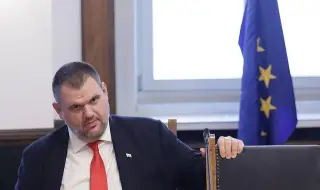
Peevski has well learned the lessons from Dogan's political textbook, even though they are hopelessly outdated. And most of all the rule: “When it gets tough, play the ethnic card!”. Because it is an instrument of pressure and fear.
Dogan's political textbook is hopelessly outdated in this century, but one rule in it can still be used: “When it gets tough, play the ethnic card!” This card is embedded in the foundations and affirmation of the DPS. Dogan kept it ready as a political detonator - its power was in the fear that it could be activated at any moment.
There was no ethnic element in the protests
The current leader of the DPS-New Beginning, Delyan Peevski, is emancipating himself from his godfather in politics, but the old lessons serve him well. He threatened the PP-DB that he would not allow them to "sow" ethnic hatred. Despite the fact that in the two protests against the government, attended by thousands of people, there was no ethnic element whatsoever, but demands for the resignation of the cabinet and "Peevski to disappear from politics", Peevski erupted in the parliamentary lobby that only his voters could demand his resignation. And then he warned: "I advise them not to sow hatred, and ethnic hatred at that - my brothers, Turks, Pomaks, Roma, were shown on the screens. I will not allow them to do this as their leader. If they sow hatred, they will reap hatred”.
The protests are an expression of value-based, not ethnic opposition, and hardly anyone will take seriously the phantasmagoria of ethnic-based hatred, even the Bulgarian Muslims, whom Peevski - like his teacher Dogan - puts under a lid. If today's nationalists preached “hatred” of the Turks, as their ancestors did in the 90s until the beginning of this century, and some Volensiderovets were found to bloodily stain the Friday prayer in the Sofia mosque “Banya Bash”, the picture could have been achieved. But not anymore.
Today's staunch patriots have chosen the European Union, the single European currency and, in general, everything with the euro as their opponent, and are so carried away by everything Russian that they misspell the beautiful word "referendum". The poster hung yesterday by "Vazrazhdane" in the parliament hall read: "Referendum for the leva! No to the euro!". But since Βig Boss said that there is ethnic hatred and his "brothers" were insulted at the protests, then it is so. Even though it is not so. And the orchestrated spontaneity erupted in the form of declarations from structures of the MRF-NN with Peevski's new motto: "No to hatred!" and thanks “to Mr. Peevski for not allowing Bulgarian citizens to be divided and opposed - Bulgarians, Turks, Pomaks, Millets, Roma”.
The free against the unfree
Do we see Bulgarians and Turks as the same when Peevski talks about non-existent ethnic hatred? In times of economic crisis and social discontent, part of society seeks “protection” and the call for ethnic solidarity can entice people from minorities to support those who promise them protection. The MRF has always encapsulated Bulgarian Muslims. Almost everything related to them is interpreted through the prism of the leader and his circle, and individual voices often go unnoticed - to the extent that they exist. Even among political scientists and sociologists analyzing and researching the processes, representatives of this minority are (almost) not to be found.
In social terms, this leads to caution in the public space, because any criticism of the party or its leader is perceived as a betrayal of the community. At the same time, Peevski is presented as a guarantor of the protection of this group and its political representation, as its authentic voice. Thus, the ethnic map functions not only as an instrument of fear and pressure, but also as a mechanism that limits the political autonomy of Muslims.
If the leader of the MRF-NN, sanctioned for corruption by the US and the UK, was truly concerned about his voters, the first shelves with “food for the people” should have been in areas with a mixed population. Instead, they will be in 55 smaller settlements in the Plovdiv region in COOP stores: oil, beans, rice, flour, yogurt, cheese, yellow cheese, bread, butter, canned goods, sausages, chutney and other essential goods.
If he really thought about the rights of his voters, and not about imaginary threats and how to win overseas favor, Peevski would not have attacked philanthropist George Soros, one of the world-renowned defenders of minority rights, whose Open Society Foundations has invested $24.2 billion in various programs over the more than thirty years since its creation.
A tool for subjugation
The “ethnic card” is not just a tool created by puppeteers from the former secret services. In the Balkans, it has its own bloody history and has proven that fear and division can be turned into a weapon that works for decades, even when real conflicts have passed.
Peevski uses the “ethnic card” not to protect the real interests of the community, but to create an illusion of danger. But he cannot claim the title of “guarantor of ethnic peace”, because the honorary chairman will carry it for life. Imaginary hatred may be a kind of guarantee for his control, but not for long.
Bulgarians, Turks, Pomaks, Millets, Roma - we are all aware of who and how is lying and robbing us.
This comment expresses the personal opinion of the author and may not coincide with the positions of the Bulgarian editorial office and the State News Agency as a whole.